
EDITOR'S NOTE: The following article was written by a University of North Carolina Wilmington undergraduate student and reflects the author’s independent perspective and experience with the Terrapin Tally project. We are pleased to share this piece in support of the author’s experience with the project, student science communication, and coastal education.
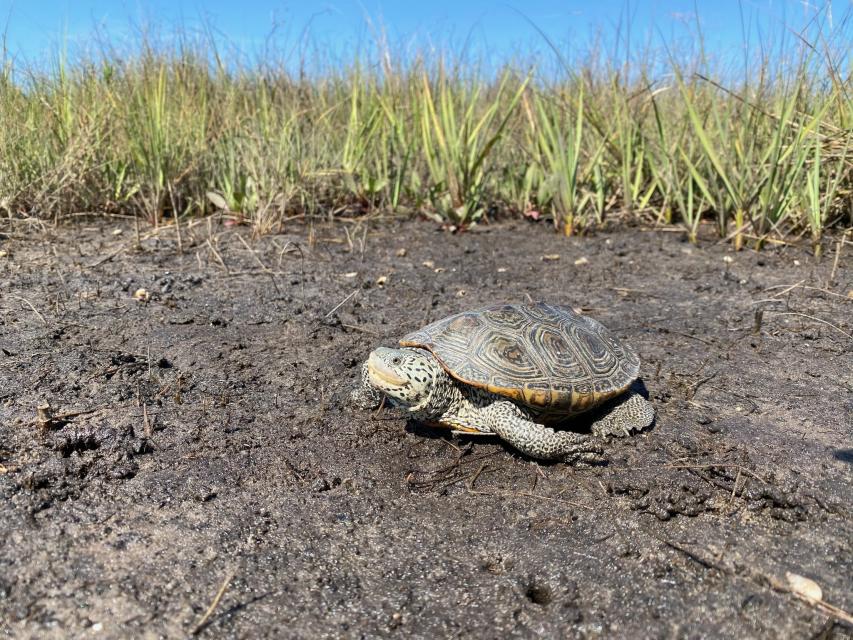
Diamondback terrapins are a species of turtle that lives along the East Coast. They are partial to brackish estuarine waters, a mix of salt and freshwater, which makes their residence a thin strip of coast from Massachusetts to Texas.
Known for the diamond shape on their shells, they have become a pseudo mascot for North Carolina conservation. Thanks to the N.C. Coastal Reserve & National Estuarine Research Reserve and Wildlife Resources Commission, the species has gained popularity and awareness.
The Terrapin Tally Story
The story of the Terrapin Tally is one of hope and perseverance, and kind-hearted folks. A grassroots species protection effort caught traction in 2014, along the waters of Masonboro Island Reserve.
But the turtle's tale started long before then.
Diamondback terrapins were once vast in population, but due to the delicacy of turtle soup, their numbers heavily declined at the beginning of the 20th century. Unlike other turtles, which are known to lay hundreds of eggs at a time, these estuarine-dwellers only produce about four to 18 eggs during their mating season. Thus, the renewal of the population has been a slow and steady trot, and the diamondback terrapin is in danger of disappearing.
Eleven years ago, the N.C. Coastal Reserve & National Estuarine Research Reserve (NCNERR) and the N.C. Wildlife Resources Commission (NCWRC) started working to address the population and environmental conditions of the diamondback terrapin. Unfortunately, data was lacking regarding the turtle's lifestyle and overall distribution.
To combat the incomplete dataset, the NCNERR and NCWRC partnered to create the Terrapin Tally. This project collects terrapin sighting data at multiple sites along the N.C. coast, including Masonboro Island, via recreational kayakers. Trained volunteers scan the surface of the water as they paddle predefined routes through the marsh, looking for a small terrapin head to surface for a breath and submit their observations as they paddle. This data is then used by scientists who can promote policy change to help protect the species.

The Terrapin Tally gained national recognition in June of 2023 when WHQR reporter, Kelly Kenoyer, ventured out to the Cape Fear River Basin. She hopped in a kayak to participate in the annual tally and published a piece on behalf of her 2.5-mile endeavor. Like the other volunteers, she filled out a survey using a data-gathering app to detail her observations. NPR published her story.
Events like these have rippling effects that extend into the local community. Advocating for a species and its conservation serves as a message of hope and unity, more powerful as it is communicated by an invested public and supported by scientists.
Interestingly, seeking help for these turtles also extends far south of North Carolina. In 2020, conservation groups filed for protections in Florida, asking the Florida Fish and Wildlife Conservation Commission to enforce regulations to protect diamondback terrapins from drowning in crab pots. Three years later, the use of Bycatch Reduction Devices (BRD) was enforced in recreational crab traps to prevent trapping turtles. North Carolina conservationists also promote the use of BRD and specifically mandate them within Diamondback Terrapin Management Areas (DTMA) in select areas in southeast North Carolina.
And in June of 2024, the Town of Oyster Bay in New York partnered with Friends of the Bay to sponsor a similar initiative: Terrapin Survival and Beach Clean Up Day. The volunteers in this community were trained to observe terrapin nests and place a protective cage around them to prevent predators from depleting the already vulnerable population.
Where are we now?
On September 19, 2024, the Center for Biological Diversity and 20 other partner organizations petitioned NOAA Fisheries to list the diamondback terrapin under the Endangered Species Act. The petition describes the loss of these turtles as having declined by 75% across their habitat range within the last 50 years.
This 130-page petition has already undergone its first judgment, known as the "90-day finding," where NOAA accepts or dismisses the petition with a positive or negative conclusion.
Luckily, the diamondback terrapins passed onto the next consideration of protection known as the "12-month finding" where their status will be reviewed, and a decision will be made whether to list the species as endangered. As of April 2026, this decision is still pending.
If not listed, the terrapins face a tumultuous future where their populations are under threat due to numerous stressors, including bycatch, habitat loss, climate change, and sea level rise.
However, if listed, the terrapins would have federal protections to ensure their conservation, including prohibition of killing or harming the species as well as critical habitat protection. With a protected status for the terrapins, future research would aid in recovery plans and hopeful renewal of the diamondback population.
What to do?
The future of the diamondback terrapin hangs in limbo, but for now, the mission still prevails: conservation, education, and community. This year, the Terrapin Tally will conduct its annual data collection surveys throughout the next month.
For more info regarding dates, times, and routes, visit the link here.