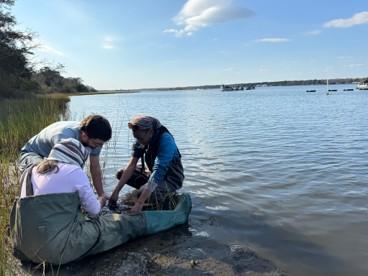
Each year, North Carolina Sea Grant and the North Carolina Coastal Reserve & National Estuarine Research Reserve team up to award a North Carolina graduate student the Coastal Research Fellowship. Sam Holberg, a doctoral student in biological and agricultural engineering at N.C. State University, wrapped up his fellowship in June 2026 and shared his research and experience with us.
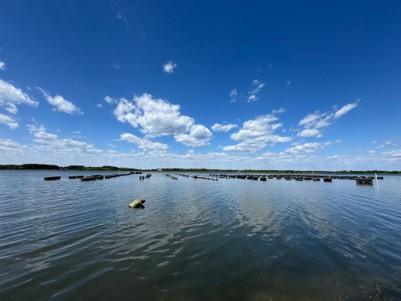
Sam’s research investigates the potential of floating- gear oyster farming being used as a hybrid nature-based strategy to slow or prevent coastal erosion. Sam collected data from erosion hotspots around Permuda Island Reserve, a component of the N.C. Coastal Reserve located near Topsail Island. He compared the erosion rates from areas with and without oyster farms, as well as the relationship between erodibility and concentrations of organic material in the sediment.
Oyster farming is a rapidly growing industry in North Carolina. Currently, aquaculture is the fastest-growing protein industry, so some estuaries in the state are rapidly being converted into oyster farming operations.
Sam sees this as an opportunity for positive environmental change.
“If the farms are going to exist, we might as well leverage them to protect our vulnerable coastal areas,” he says. “I hope that in the future, strategic placements of oyster farming operations could be used to protect the areas most exposed to coastal erosion hotspots, like Permuda Island Reserve.”
Sam’s interest in oyster farms’ impacts on water quality and erosion started during his master’s research. Oysters produce highly organic material in the water column, so he wanted to investigate the impact of oyster farming on sediment composition. He hypothesized that near oyster farms, these elevated levels of organic matter in the surrounding sediment would make the sediment harder to erode.
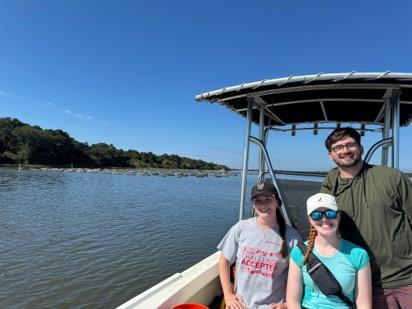
Building off his master’s thesis, Permuda Island’s assortment of oyster farms immediately piqued Sam’s curiosity. Unlike many oyster farms, the ones there are very close to shore, which, combined with an inconsistent level of erosion across the island, provided an ideal spot for data collection and comparison.
Since floating oyster farms emit organic matter into the water, it later settles into the sediment. Sam found that the increased organic material in sediments decreases the amount of sediment that erodes away on the island, which supports his hypothesis that oyster farms might help decrease sediment erodibility on Permuda Island.
Following the completion of his fellowship, Sam wants to measure the impact oyster farms have on water velocity, something he has wanted to include in his project since the start and eventually expand to other areas of the state.
In addition to his research, Sam participated in an outreach opportunity in Wake County, where he presented information about estuarine habitats to middle schoolers. This included creating various scenarios with seagrass beds and a flume, which is a device that simulates water flow.
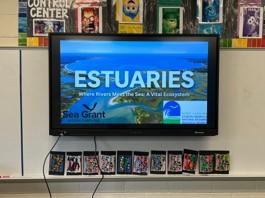
“The students were able to see that coastal ecosystems, like seagrass beds, protect our coastlines from the energy of waves and storm surge.”
He also hopes to present his research findings at the N.C. Coastal Conference in the fall of 2026.
Keep reading to find out more about Sam’s research and career journey:
Why did you become a scientist?
Growing up in the PeeDee region of South Carolina, I was always surrounded by swamps and wetlands, and I wanted to be a park ranger and work outdoors. I didn’t really know what a scientist was or that it was a career option. I really liked math in high school, so my math teacher recommended that I go to school for engineering. As an engineer, I knew I wanted to design and build things, but through a project looking at oyster reef restoration structures as an undergraduate, I realized that I could use my engineering background to become an environmental scientist!
What inspired you to start a career in this field? What are you looking forward to?
As a kid, I was always camping and being forced to go outside. I grew up every summer going to coastal South Carolina, and just fell in love with the marsh and estuarine ecosystems. I love math, so becoming an engineer was an obvious choice. As an undergraduate, I learned about ecological engineering and how we can leverage math to engineer our natural ecosystems. At N.C. State, I was able to combine my interests in coastal ecosystems and ecological engineering with my graduate degree.
I think more and more people are becoming aware of how important our environment is. Restoration and conservation are becoming increasingly important and more practical. I think over time, coastal ecological engineering will grow to be a huge industry, and I am looking forward to continuing work in this space.
What is your favorite aspect of your research? Coolest aspect?
Fieldwork! As an engineer, I spend a lot of time behind a computer screen. My research gets me out of the office and into coastal ecosystems. I also just really enjoy being out on the water, and any opportunity to get on a boat for work, I will happily take.
The coolest aspect of this project was seeing an oyster farm in operation. It’s not often we see where our food is produced, and oyster farming is one of the newest (and most unique) farming techniques. I am also a big oyster fan, so I will definitely eat more oysters after working on this project.
What has been your most surprising finding?
A surprising finding, although not a positive one, was that oyster farms make the water column so clear that our velocity measurement instrument (Acoustic Doppler Current Profiler) wasn’t able to record data, as it needs particles in water to record data. Not great for our data collection, but it was surprising to see the water so clear in the intracoastal waterway.
What is your best or worst field story?
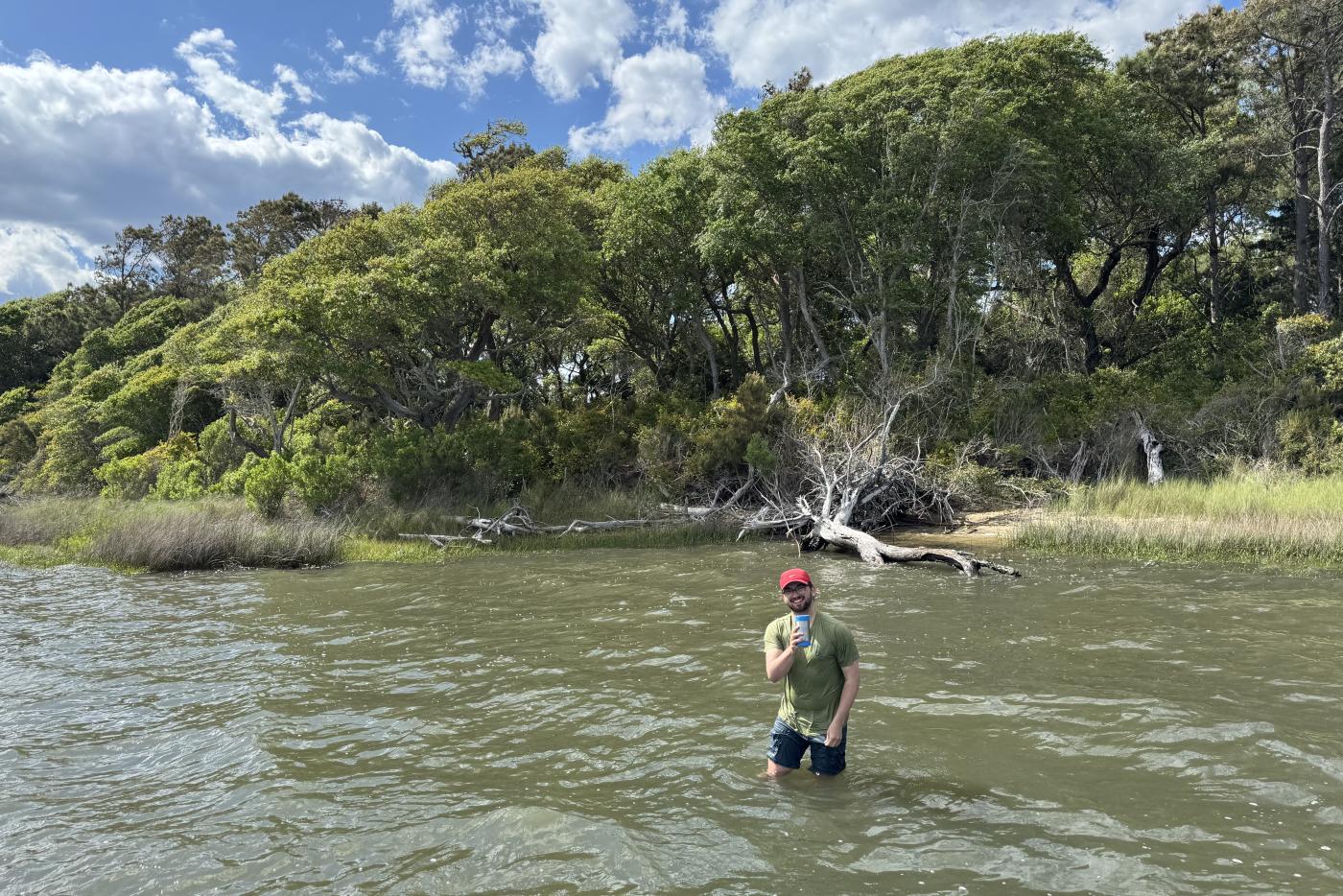
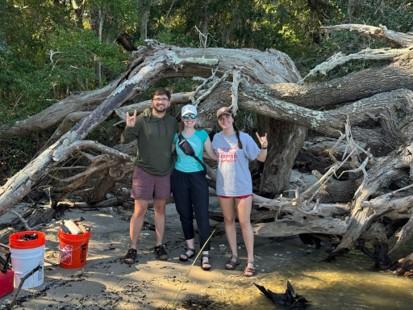
A lot of this project involved taking push core samples near Permuda Island. For push core sampling, it’s really easy to just push the sediment core into the ground, dig a little bit, and remove the sample. This worked great the first trip when most of my samples were in ~1 foot of water (low tide). The next visit, I needed replicates, and what was once 1 foot of water was now 3-4 feet of water. I got more wet than I expected that day (see picture). Fieldwork is always a little bit messy and a little unpredictable. Every time I go out in the field, it is a fun day!
Sam’s Advice? Always check the tide chart when doing coastal fieldwork.
What will you take away from this experience?
This has been a very rewarding experience. I was able to participate in the entire research process, from writing the proposal, collecting the field data, analyzing the data, and hopefully publishing the results. Working with stakeholders was also extremely rewarding. Working alongside Sea Grant extension agents and giving presentations to professionals in the coastal management field was something I would not have experienced in my PhD if it weren’t for this fellowship.