
LCFRP MOA 2026-2031

Memorandum of Agreement
Between
The State of North Carolina’s Division of Water Resources
And
The Lower Cape Fear River Program Permittees
Effective:
July 1, 2026 through June 31, 2031
This page was intentionally left blank.
MEMORANDUM OF AGREEMENT
This Memorandum of Agreement (MOA) is entered into this 1st day of July 2026, by and among the NORTH CAROLINA DEPARTMENT OF ENVIRONMENTAL QUALITY’S DIVISION OF WATER RESOURCES (DWR), the NATIONAL POLLUTANT DISCHARGE ELIMINATION SYSTEM (NPDES) DISCHARGERS in the Lower Cape Fear River Basin who have voluntarily executed this MOA (LCFRP PERMITTEES), and the LOWER CAPE FEAR RIVER BASIN ASSOCIATION (LCFRP), a non-profit corporation whose members include the LCFRP PERMITTEES (see Table 1).
WITNESSETH, THAT,
Whereas, the LCFRP Permittees have instream (e.g., upstream and downstream) monitoring requirements in their respective NPDES permits pursuant to Federal and State law.
Whereas, the DWR has obligations to collect water quality data, which it uses for various purposes, including but not limited to enforcement, regulatory, scientific, and educational purposes.
Whereas, DWR has discretion in determining instream sampling locations in the context of NPDES permitting.
Whereas, the LCFRP Permittees are willing to combine their resources to provide for a more efficient and effective method for instream monitoring to meet the requirements of their respective NPDES permits.
Whereas, all parties to this MOA benefit from the collection of instream water quality data in the Lower Cape Fear River Basin.
NOW, THEREFORE, in consideration of mutual benefits that will accrue to each party, the parties agree as follows:
Purpose:
- The purpose of this MOA is to:
- facilitate the collection of instream water quality data for parameters that are of interest to all parties to this MOA;
- facilitate the collection of instream water quality data at preferred sampling locations (i.e., to reduce duplicative sampling locations and to sample at locations that would otherwise not be sampled) which are mutually agreeable to the both parties;
- facilitate the collection of instream water quality data at frequencies that provide useful information to all parties to this MOA;
- leverage the resources available to the parties of this MOA for instream sampling; and
- provide all parties with consistent instream water quality data for the Lower Cape Fear River Basin.
General Provisions:
- This MOA only applies to the collection and submission of instream water quality monitoring data for the parameters, locations, and frequencies identified in Table 2.
- Nothing in this MOA precludes DWR from requesting LCFRP Permittees or LCFRP to take additional samples. Similarly, there is nothing in this MOA that precludes LCFRP Permittees or LCFRP to voluntarily conduct and submit sampling data to DWR in addition to what is set forth in Table 2, including hardness and emerging contaminants.
- This MOA does not relieve LCFRP Permittees from complying with other NPDES permit requirements, including influent and effluent monitoring requirements, or other Federal and State laws, including State water quality standards.
- By signing this MOA, the LCFRP PERMITTEES authorize the LCFRP to act as their agent and on their behalf in collecting and submitting instream monitoring data to DWR for the parameters listed in Table 2.
- The LCFRP PERMITTEES are exempted from instream water quality monitoring for certain parameters as specified in their individual NPDES permits. If there is any discrepancy or conflict between this MOA and an LCFRP Permittee’s NPDES permit, the LCFRP Permittee’s NPDES permit shall prevail.
Collection of instream water quality data:
- The LCFRP and its agents shall perform the collection and analyses of the instream water quality monitoring data for the parameters, locations and frequencies specified in Table 2 of this MOA.
- The LCFRP will contract for the performance of the monitoring activities with a laboratory appropriately certified by DWR for the required laboratory and field analysis.
- The LCFRP and its agents shall comply with the requirements and protocols set forth in Tables 3 and 4 located in Appendix A.
Submission of (monthly) instream water quality data to DWR:
- The LCFRP shall submit the monitoring results to DWR on behalf of LCFRP PERMITTEES.
- The LCFRP shall submit the water quality data to the DWR within 90 days of the end of the month in which the sampling was performed to the Coalition Coordinator at [email protected].
- The LCFRP or its agents shall submit the water quality data to the DWR in a format set forth in Table 5 located in Appendix B of this MOA and preferably in Microsoft® Excel.
- The LCFRP shall archive all data for five (5) years.
- The LCFRP PERMITTEES may provide comments to DWR on data and work submitted by LCFRP to DWR.
- Failure by the LCFRP PERMITTEES or the LCFRP or their agents to collect or analyze the water quality data as described in this MOA, or to provide data to the DWR in the required format, may result in the termination of this MOA by the DWR and the return to individual upstream and downstream monitoring requirements, as specified in the individual NPDES permits for each of the LCFRP PERMITTEES.
- Special and/or additional data collected (e.g., hardness) at a designated monitoring station concurrently with the regularly scheduled samples, should be submitted to the Coalition Coordinator.
Annual Report:
- The LCFRP shall submit an annual written report that summarizes the previous calendar year’s sampling activities.
- The LCFRP shall submit the annual report no later than April 30th each year that this MOA is in effect and shall comply with the requirements set forth in Appendix B.
- The LCFRP shall submit the annual report to the DWR Coalition Coordinator at 1621 Mail Service Center, Raleigh, NC 27699-1621 or electronically at [email protected].
Signatures for all Submissions to DWR:
- The LCFRP Chair shall sign annual reports submitted to DWR pursuant to this MOA.
Special Circumstances affecting sampling:
- Stream sampling under this MOA may be suspended or discontinued under the following circumstances:
- If flow conditions in the receiving waters and/or extreme weather conditions will result in a substantial risk of injury to the person(s) collecting samples; or
- If environmental conditions, such as a dry stream, prevent sample collection.
- If sampling is suspended or discontinued for any reason, the LCFRP shall provide a written explanation to DWR explaining why sampling was not performed. The written explanation shall be submitted to the DWR Coalition Coordinator with LCFRP’s monthly data submittal (electronic submittal is authorized).
- If sampling is suspended or discontinued under the provisions above, LCFRP shall resume stream sampling as soon as possible.
Modification:
- This MOA may be modified by the written consent of the DWR and the LCFRP. Either DWR or the LCFRP may determine that it is necessary to request changes in monitoring frequency, parameters, and/or sampling locations. Any changes to sampling parameters, locations, or frequencies shall be made by a written amendment to this MOA agreed to by the DWR, the LCFRP PERMITTEES, and the LCFRP. The amendment shall be signed by the LCFRP chair
and by the DWR Director. Such amendments may be entered into at any time.
New Parties to this MOA:
- The following additional NPDES permit dischargers may enter into this MOA subsequent to the effective date hereof:
- Dischargers who receive a NPDES permit within the Lower Cape Fear River Basin, or
- Dischargers who have NPDES permits within the Lower Cape Fear River Basin but are not parties to this Agreement.
- The addition of such dischargers to this MOA may be made only with the consent of the DWR, the LCFRP PERMITTEES, and the LCFRP and shall require a written amendment to this MOA signed by the LCFRP chairperson, by the DWR, and by an authorized representative of any such discharger who wishes to enter into the MOA. The DWR will not unreasonably withhold consent to the addition of a discharger to the MOA. The DWR will consider modification of the existing monitoring program described in this MOA for the addition of a NPDES permit discharger to the MOA. Such amendments may be made at any time that this MOA is in effect. The LCFRP PERMITTEES included in this MOA are listed in Table 1.
Term:
- This MOA shall be effective upon the signature until June 30, 2031, unless extended by the consent of both the DWR Director and the LCFRP.
Withdraw/Termination as between DWR and LCFRP:
- Upon sixty (60) days written notice, the DWR or the LCFRP may terminate this MOA for any reason. Upon termination of this MOA, the monitoring requirements contained in the individual NPDES permit for each LCFRP PERMITTEE shall become effective immediately.
Withdraw/Termination as between DWR and individual LCFRP Permittees:
- An individual permit holder may withdraw and cancel its participation in this MOA by providing sixty (60) days written notice to the LCFRP, and sixty (60) days written notice to the DWR Coalition Coordinator, the appropriate DWR Regional Office(s), and the DWR Water Quality Permitting Section. The monitoring requirements contained in the individual NPDES permit shall become effective upon the termination date specified in the notice.
- The withdrawal of an individual LCFRP Permittee shall require a written amendment to this MOA signed by the LCFRP chair and the DWR Director.
- In the event a LCFRP NPDES permit holder terminates or cancels its participation in this MOA or its membership in the LCFRP is terminated for any reason, the LCFRP may request that DWR review the monitoring plan described in this MOA for a possible reduction in sampling effort and/or requirements.
No limitation on use of the data:
- There are no limitations on DWR’s, LCFRP, or LCFRP Permittee’s use of the data collected under this MOA.
Entire Agreement:
- This MOA constitutes the entire agreement between the parties and supersedes all previous agreements.
Incorporation:
- Appendices A and B are attached to and incorporated into this MOA.
Savings Clause:
- Should any part of this Agreement be declared invalid or unenforceable by a court of competent jurisdiction, invalidation of the affected portion shall not invalidate the remaining portions of the Agreement and they shall remain in full force and effect.
Remedies for Breach:
- The only remedy for breach of this MOA is an action for specific performance or injunction.
IN WITNESS WHEREOF, the parties have caused the execution of this instrument by authority duly given, to be effective as of the date executed by the DWR.
DIVISION OF WATER RESOURCES
By: signature on file
Roger E. Richards, Jr.
Director
Division of Water Resources, DEQ
Date: ________________________
LOWER CAPE FEAR RIVER PROGRAM
By: signature on file
Beth Eckert
Chairman
Lower Cape Fear River Program
Date: ________________________
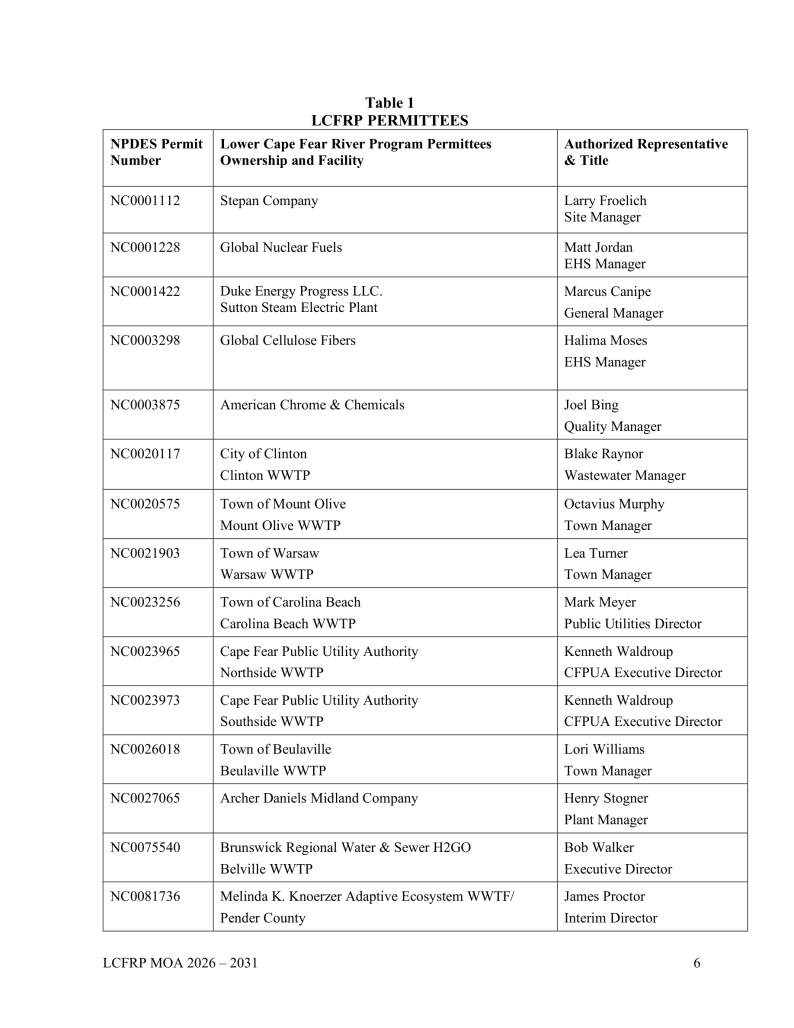
| NPDES Permit Number | Lower Cape Fear River Program Permittees Ownership and Facility | Authorized Representative & Title |
|---|---|---|
| NC0001112 | Stepan Company | Larry Froelich Site Manager |
| NC0001228 | Global Nuclear Fuels | Matt Jordan EHS Manager |
| NC0001422 | Duke Energy Progress LLC. Sutton Steam Electric Plant |
Marcus Canipe General Manager |
| NC0003298 | Global Cellulose Fibers | Halima Moses EHS Manager |
| NC0003875 | American Chrome & Chemicals | Joel Bing Quality Manager |
| NC0020117 | City of Clinton Clinton WWTP |
Blake Raynor Wastewater Manager |
| NC0020575 | Town of Mount Olive Mount Olive WWTP |
Octavius Murphy Town Manager |
| NC0021903 | Town of Warsaw Warsaw WWTP |
Lea Turner Town Manager |
| NC0023256 | Town of Carolina Beach Carolina Beach WWTP |
Mark Meyer Public Utilities Director |
| NC0023965 | Cape Fear Public Utility Authority Northside WWTP |
Kenneth Waldroup CFPUA Executive Director |
| NC0023973 | Cape Fear Public Utility Authority Southside WWTP |
Kenneth Waldroup CFPUA Executive Director |
| NC0026018 | Town of Beulaville Beulaville WWTP |
Lori Williams Town Manager |
| NC0027065 | Archer Daniels Midland Company | Henry Stogner Plant Manager |
| NC0075540 | Brunswick Regional Water & Sewer H2GO Belville WWTP |
Bob Walker Executive Director |
| NC0081736 | Melinda K. Knoerzer Adaptive Ecosystem WWTF/ Pender County |
James Proctor Interim Director |
| NC0082295 | Fortron Industries, LLC/Celanese | Kevin Sproull Plant Manager |
| NC0086819 | Brunswick County NE Brunswick Regional WWTP |
Steve Stone County Manager |
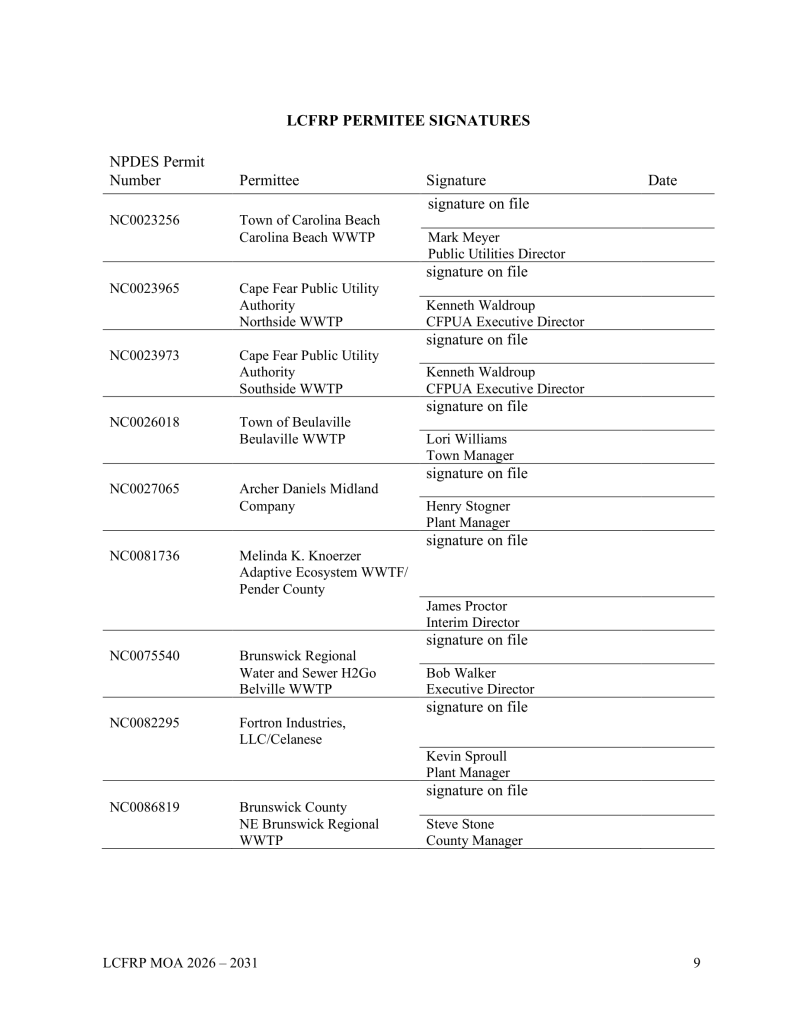
LCFRP PERMITEE SIGNATURES
| NPDES Permit Number | Permittee | Signature | Date |
|---|---|---|---|
| NC0001112 | Stepan Company | signature on file Larry Froelich Site Manager |
|
| NC0001228 | Global Nuclear Fuels | signature on file Matt Jordan Environmental Health & Safety Manager |
|
| NC0001422 | Duke Energy Progress LLC Sutton Steam Electric Plant |
signature on file Marcus Canipe General Manager |
|
| NC0003298 | Global Cellulose Fibers | signature on file Halima Moses Environmental Health & Safety Manager |
|
| NC0003875 | American Chrome & Chemicals | signature on file Joel Bing Quality Manager |
|
| NC0020117 | City of Clinton Clinton WWTP |
signature on file Blake Raynor Wastewater Treatment Manager |
|
| NC0020575 | Town of Mount Olive Mount Olive WWTP |
signature on file Octavius Murphy Town Manager |
|
| NC0021903 | Town of Warsaw Warsaw WWTP |
signature on file Lea Turner Town Manager |
|
| NC0023256 | Town of Carolina Beach Carolina Beach WWTP |
signature on file Mark Meyer Public Utilities Director |
|
| NC0023965 | Cape Fear Public Utility Authority Northside WWTP |
signature on file Kenneth Waldroup CFPUA Executive Director |
|
| NC0023973 | Cape Fear Public Utility Authority Southside WWTP |
signature on file Kenneth Waldroup CFPUA Executive Director |
|
| NC0026018 | Town of Beulaville Beulaville WWTP |
signature on file Lori Williams Town Manager |
|
| NC0027065 | Archer Daniels Midland Company | signature on file Henry Stogner Plant Manager |
|
| NC0081736 | Melinda K. Knoerzer Adaptive Ecosystem WWTF/ Pender County |
signature on file James Proctor Interim Director |
|
| NC0075540 | Brunswick Regional Water and Sewer H2Go Belville WWTP |
signature on file Bob Walker Executive Director |
|
| NC0082295 | Fortron Industries, LLC/Celanese | signature on file Kevin Sproull Plant Manager |
|
| NC0086819 | Brunswick County NE Brunswick Regional WWTP |
signature on file Steve Stone County Manager |
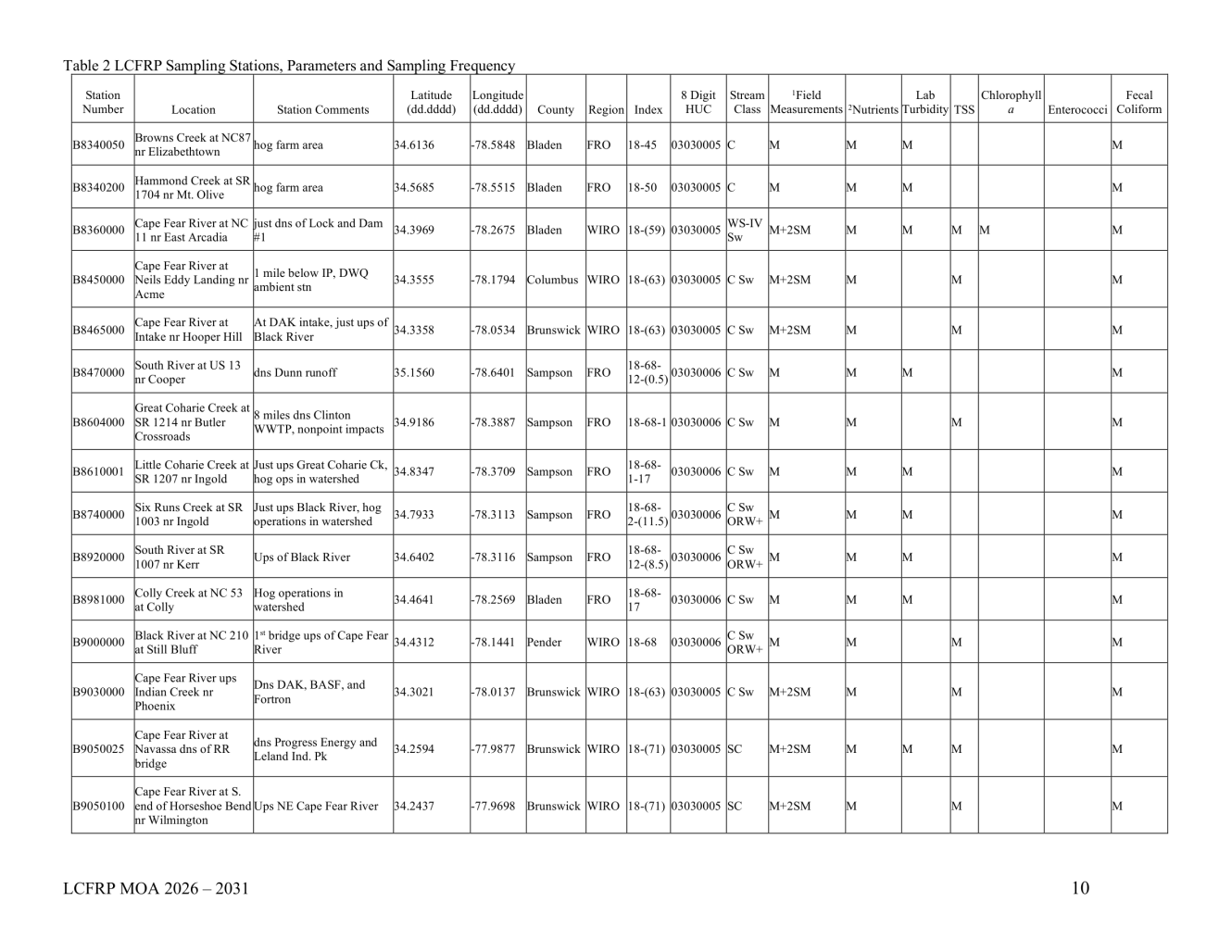
| Station Number | Location | Station Comments | Latitude (dd.dddd) | Longitude (dd.dddd) | County | Region | Index | 8 Digit HUC | Stream Class | 1Field Measurements | 2Nutrients | Lab Turbidity | Lab TSS | Chlorophyll a | Enterococci | Fecal Coliform |
|---|---|---|---|---|---|---|---|---|---|---|---|---|---|---|---|---|
| B8340050 | Browns Creek at NC87 nr Elizabethtown | hog farm area | 34.6136 | -78.5848 | Bladen | FRO | 18-45 | 03030005 | C | M | M | M | M | |||
| B8340200 | Hammond Creek at SR 1704 nr Mt. Olive | hog farm area | 34.5685 | -78.5515 | Bladen | FRO | 18-50 | 03030005 | C | M | M | M | M | |||
| B8360000 | Cape Fear River at NC 11 nr East Arcadia | just dns of Lock and Dam #1 | 34.3969 | -78.2675 | Bladen | WIRO | 18-(59) | 03030005 | WS-IV Sw | M+2SM | M | M | M | M | M | |
| B8450000 | Cape Fear River at Neils Eddy Landing nr Acme | 1 mile below IP, DWQ ambient stn | 34.3555 | -78.1794 | Columbus | WIRO | 18-(63) | 03030005 | C Sw | M+2SM | M | M | M | |||
| B8465000 | Cape Fear River at Intake nr Hooper Hill | At DAK intake, just ups of Black River | 34.3358 | -78.0534 | Brunswick | WIRO | 18-(63) | 03030005 | C Sw | M+2SM | M | M | M | |||
| B8470000 | South River at US 13 nr Cooper | dns Dunn runoff | 35.1560 | -78.6401 | Sampson | FRO | 18-68-12-(0.5) | 03030006 | C Sw | M | M | M | M | |||
| B8604000 | Great Coharie Creek at SR 1214 nr Butler Crossroads | 8 miles dns Clinton WWTP, nonpoint impacts | 34.9186 | -78.3887 | Sampson | FRO | 18-68-1 | 03030006 | C Sw | M | M | M | M | |||
| B8610001 | Little Coharie Creek at SR 1207 nr Ingold | Just ups Great Coharie Ck, hog ops in watershed | 34.8347 | -78.3709 | Sampson | FRO | 18-68-1-17 | 03030006 | C Sw | M | M | M | M | |||
| B8740000 | Six Runs Creek at SR 1003 nr Ingold | Just ups Black River, hog operations in watershed | 34.7933 | -78.3113 | Sampson | FRO | 18-68-2-(11.5) | 03030006 | C Sw ORW+ | M | M | M | M | |||
| B8920000 | South River at SR 1007 nr Kerr | Ups of Black River | 34.6402 | -78.3116 | Sampson | FRO | 18-68-12-(8.5) | 03030006 | C Sw ORW+ | M | M | M | M | |||
| B8981000 | Colly Creek at NC 53 at Colly | Hog operations in watershed | 34.4641 | -78.2569 | Bladen | FRO | 18-68-17 | 03030006 | C Sw | M | M | M | M | |||
| B9000000 | Black River at NC 210 at Still Bluff | 1st bridge ups of Cape Fear River | 34.4312 | -78.1441 | Pender | WIRO | 18-68 | 03030006 | C Sw ORW+ | M | M | M | M | |||
| B9030000 | Cape Fear River ups Indian Creek nr Phoenix | Dns DAK, BASF, and Fortron | 34.3021 | -78.0137 | Brunswick | WIRO | 18-(63) | 03030005 | C Sw | M+2SM | M | M | M | |||
| B9050025 | Cape Fear River at Navassa dns of RR bridge | dns Progress Energy and Leland Ind. Pk | 34.2594 | -77.9877 | Brunswick | WIRO | 18-(71) | 03030005 | SC | M+2SM | M | M | M | M | ||
| B9050100 | Cape Fear River at S. end of Horseshoe Bend nr Wilmington | Ups NE Cape Fear River | 34.2437 | -77.9698 | Brunswick | WIRO | 18-(71) | 03030005 | SC | M+2SM | M | M | M | |||
| B9090000 | NE Cape Fear River at NC 403 nr Williams | Dns Mt. Olive WWTP, DWQ ambient stn | 35.1784 | -77.9807 | Duplin | WIRO | 18-74-(1) | 03030007 | C Sw | M | M | M | M | |||
| B9130000 | Panther Branch (Creek) nr Faison | Sample from Bay Valley access Rd, dns Bay Valley WWTP | 35.1345 | -78.1363 | Duplin | WIRO | 18-74-19-3 | 03030007 | C Sw | M | M | M | M | |||
| B9191000 | Goshen Swamp at NC 11 and NC 903 nr Kornegay | Major trib to NE CFR, Ag. and Hog ops in watershed | 35.0281 | -77.8516 | Duplin | WIRO | 18-74-19 | 03030007 | C Sw | M | M | M | M | |||
| B9191500 | NE Cape Fear River SR 1700 nr Sarecta | Dns Guilford Mills and Cogentrix WWTPs | 34.9801 | -77.8622 | Duplin | WIRO | 18-74-1 | 03030007 | C Sw | M | M | M | M | |||
| B9430000 | Rockfish Creek at US 117 nr Wallace | Ups Wallace WWTP2 | 34.7168 | -77.9795 | Duplin | WIRO | 18-74-29 | 03030007 | C Sw | M | M | M | M | |||
| B9460000 | Little Rockfish Creek at NC 11 nr Wallace | Ups Wallace WWTP1, benthic stn | 34.7224 | -77.9814 | Duplin | WIRO | 18-74-29-6 | 03030007 | C Sw | M | M | M | M | M | ||
| B9490000 | Angola Creek at NC 53 nr Maple Hill | benthic stn | 34.6562 | -77.7351 | Pender | WIRO | 18-74-33-3 | 03030007 | C Sw | M | M | M | M | |||
| B9580000 | NE Cape Fear River at US 117 at Castle Hayne | DWQ ambient stn, dns Elementis Chromium WWTP | 34.3637 | -77.8965 | New Hanover | WIRO | 18-74-(47.5) | 03030007 | B Sw | M | M | M | M | |||
| B9670000 | NE Cape Fear River Nr Wrightsboro | Below GNF and Arteva WWTPs | 34.3171 | -77.9538 | New Hanover | WIRO | 18-74-(52.5) | 03030007 | C Sw | M+2SM | M | M | M | |||
| B9720000 | Smith Creek at US 117 and NC 133 at Wilmington | Dns Smith Ck WWTP, urban runoff | 34.2586 | -77.9391 | New Hanover | WIRO | 18-74-63 | 03030007 | C Sw | M | M | M | M | M | ||
| B9790000 | Brunswick River dns NC 17 at park nr Belville | Park access from SR 133, dns Belville WWTP | 34.2214 | -77.9787 | Brunswick | WIRO | 18-77 | 03030005 | SC | M | M | M | M | |||
| B9795000 | Cape Fear River at Channel Marker 54 | Dns Wilmington Southside WWTP | 34.1393 | -77.9460 | New Hanover | WIRO | 18-(71) | 03030005 | SC | M+2SM | M | M | M | |||
| B9800000 | Cape Fear River at Channel Marker 61 at Wilmington | Dns Wilmington Northside WWTP, DWQ ambient stn | 34.1938 | -77.9573 | New Hanover | WIRO | 18-(71) | 03030005 | SC | M+2SM | M | M | M | M | M | |
| B9850100 | Cape Fear River at Channel Marker 35 | Ups Carolina Beach WWTP | 34.0335 | -77.9370 | Brunswick | WIRO | 18-(71) | 03030005 | SC | M+2SM | M | M | M | |||
| B9910000 | Cape Fear River at Channel Marker 23 | Dns Carolina Beach WWTP | 33.9456 | -77.9696 | Brunswick | WIRO | 18-(87.5) | 03030005 | SA HQW | M+2SM | M | M | M | |||
| B9921000 | Cape Fear River at Channel Marker 18 | Nr Mouth of Cape Fear River | 33.9130 | -78.0170 | Brunswick | WIRO | 18-88-3.5 | 03030005 | SC | M+2SM | M | M | M | M | M |
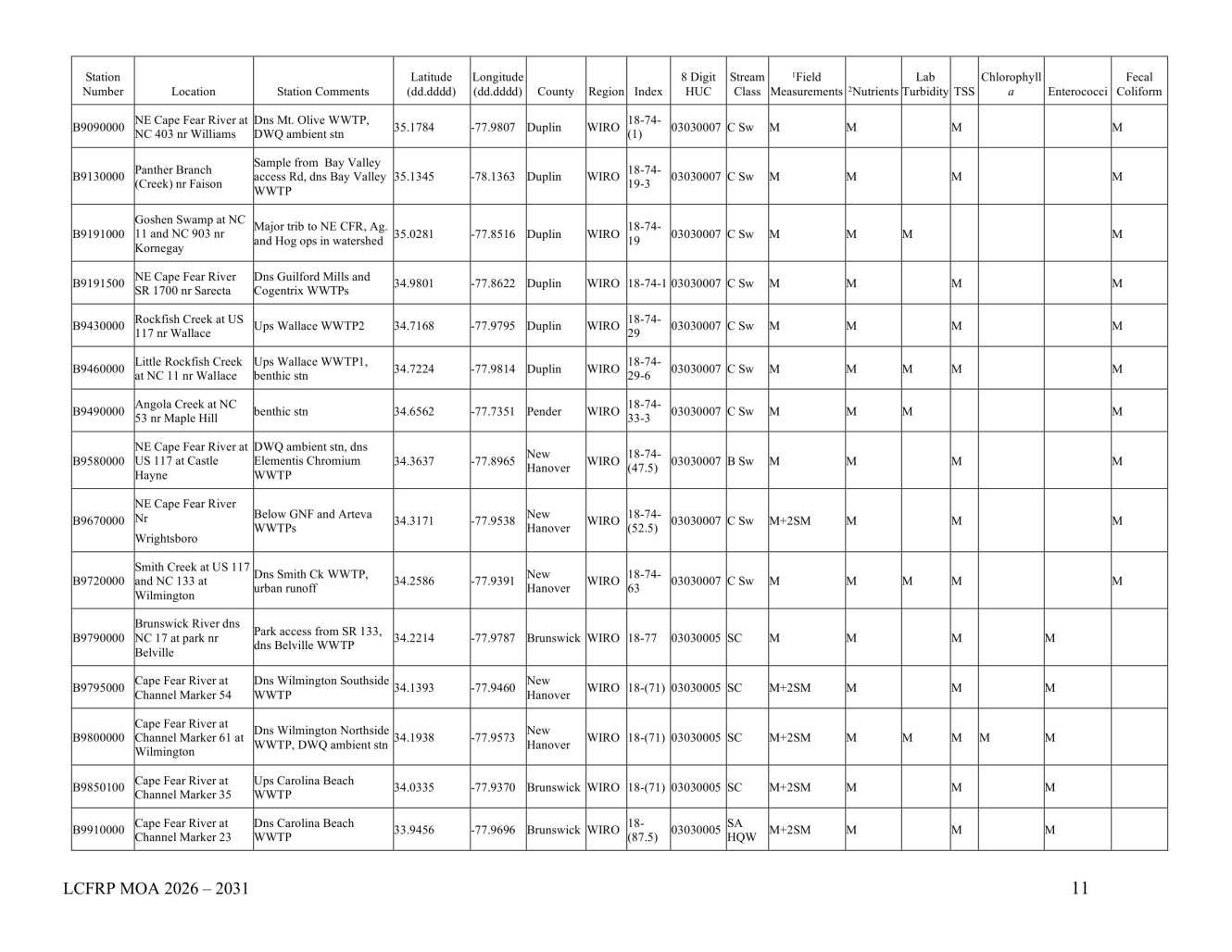
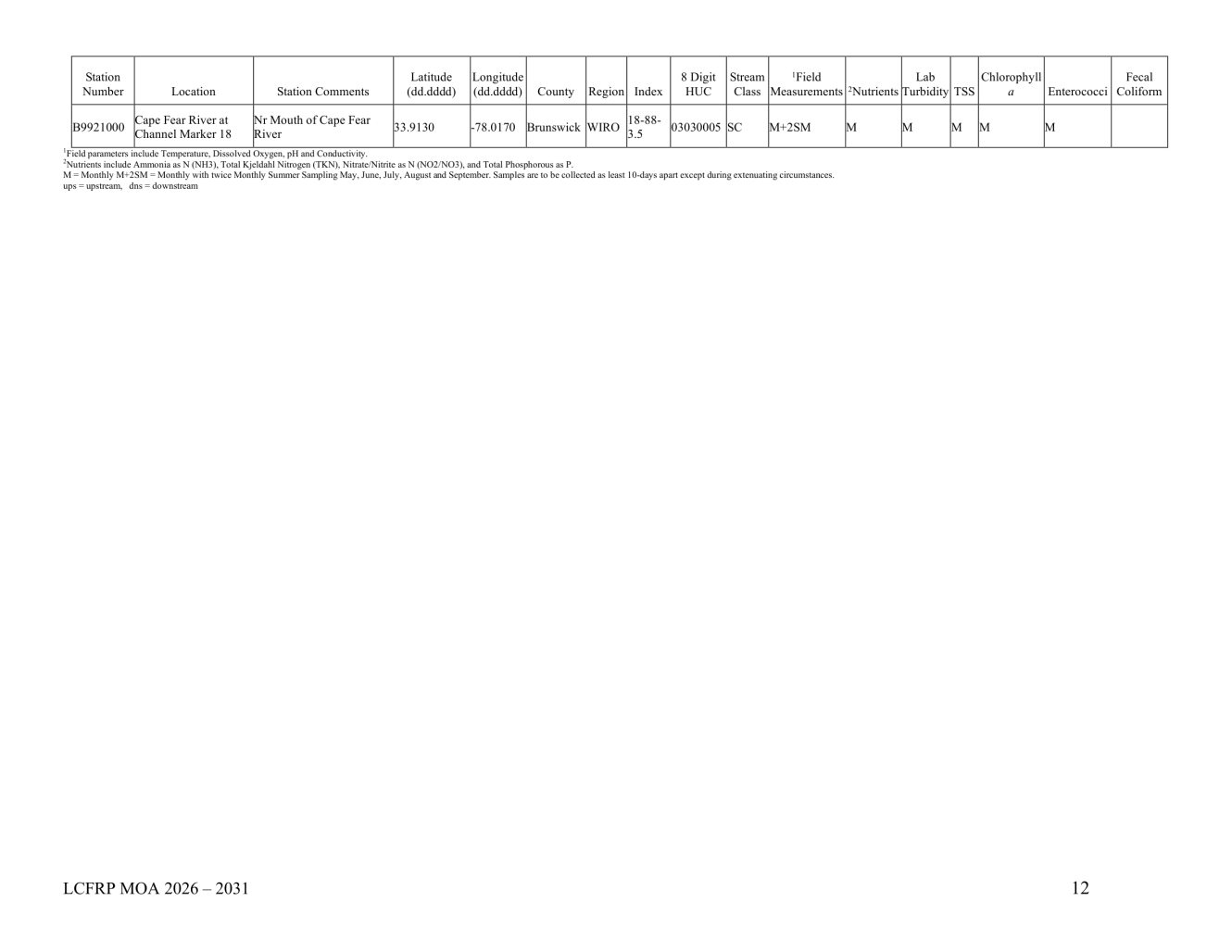
1Field parameters include Temperature, Dissolved Oxygen, pH and Conductivity.
2Nutrients include Ammonia as N (NH3), Total Kjeldahl Nitrogen (TKN), Nitrate/Nitrite as N (NO2/NO3), and Total Phosphorous as P.
M = Monthly M+2SM = Monthly with twice Monthly Summer Sampling May, June, July, August and September. Samples are to be collected as least 10-days apart except during extenuating circumstances.
ups = upstream, dns = downstream
APPENDIX A
SAMPLE COLLECTION AND ANALYSIS
Sample Collection Procedures
Sample collection shall be performed by trained personnel employed by NC DWR-certified laboratories in accordance with the DWR Monitoring Coalition Program Field Monitoring Guidance Document (November 2017) and subsequent documents. The Field Monitoring Guidance Document can be found on the web at: deq.nc.gov/about/divisions/water-resources/water-resources-data/water-sciences-home-page/ecosystems-branch/monitoring-coalition-program. Alternate collection procedures require the approval of the DWR Coalition Coordinator prior to use.
Laboratory Analysis
All laboratory analyses shall be performed at a DWR-certified laboratory using approved methods as prescribed by section 40 of the Code of Federal Regulations part 136 (40 CFR part 136) or other methods certified by the DWR Laboratory Certification Branch (deq.nc.gov/about/divisions/water-resources/water-resources-data/water-sciences-home-page/laboratory-certification-branch) or the Director of DWR. 40 CFR Part 136 can be accessed on the web at deq.nc.gov/about/divisions/water-resources/water-resources-data/water-sciences-home-page/laboratory-certification-branch/rules-regulations.
Reporting levels will be at least as stringent as the reporting levels used by the DWR Laboratory. For guidance purposes Table A-1 lists target reporting levels for each parameter based on the reporting levels of the DWR Laboratory. The lowest possible analytical limits for all the parameters should be pursued.
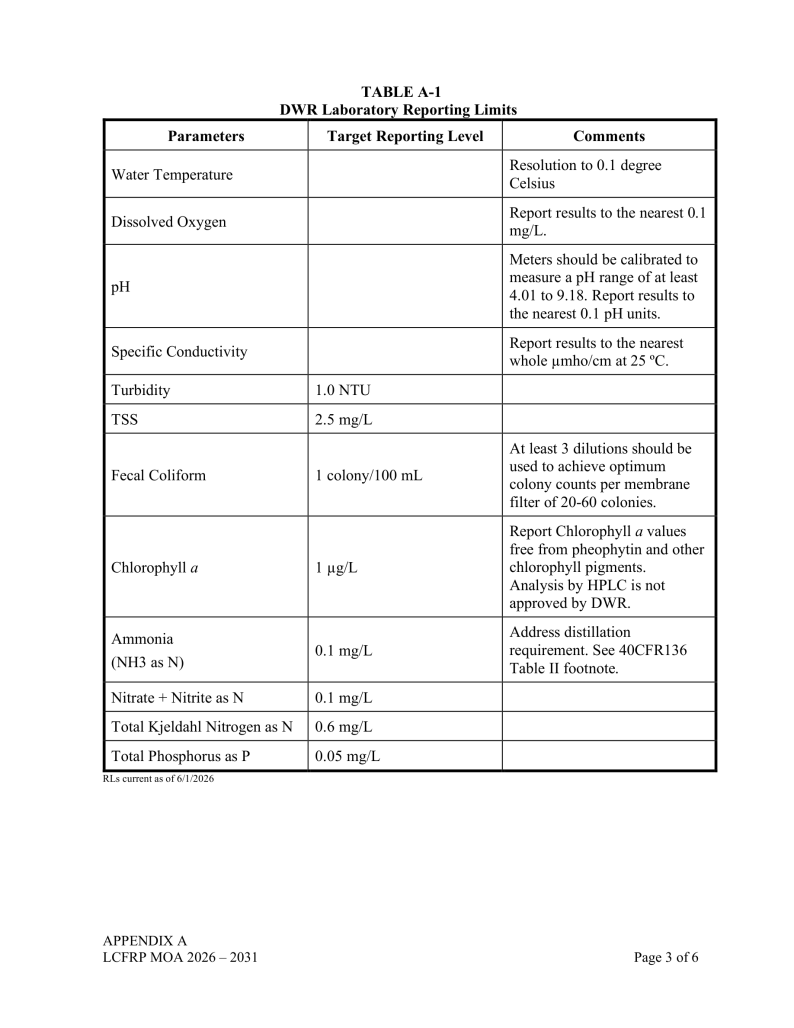
| Parameters | Target Reporting Level | Comments |
|---|---|---|
| Water Temperature | Resolution to 0.1 degree Celsius | |
| Dissolved Oxygen | Report results to the nearest 0.1 mg/L. | |
| pH | Meters should be calibrated to measure a pH range of at least 4.01 to 9.18. Report results to the nearest 0.1 pH units. | |
| Specific Conductivity | Report results to the nearest whole µmho/cm at 25 ºC. | |
| Turbidity | 1.0 NTU | |
| TSS | 2.5 mg/L | |
| Fecal Coliform | 1 colony/100 mL | At least 3 dilutions should be used to achieve optimum colony counts per membrane filter of 20-60 colonies. |
| Chlorophyll a | 1 µg/L | Report Chlorophyll a values free from pheophytin and other chlorophyll pigments. Analysis by HPLC is not approved by DWR. |
| Ammonia (NH3 as N) |
0.1 mg/L | Address distillation requirement. See 40CFR136 Table II footnote. |
| Nitrate + Nitrite as N | 0.1 mg/L | |
| Total Kjeldahl Nitrogen as N | 0.6 mg/L | |
| Total Phosphorus as P | 0.05 mg/L |
RLs current as of 6/1/2026
Data Qualification Codes
When reporting data, the DWR’s data qualifier codes must be used to provide additional information regarding data quality and interpretation. The current set of qualifier codes to be used is provided in Table A-2. Review the data remark codes at least annually and utilize the most current set, as codes are subject to change. A copy of this table can be found at deq.nc.gov/about/divisions/water-resources/water-resources-data/water-sciences-home-page/microbiology-inorganics-branch/methods-pqls-qa.
| Symbol | Definition |
|---|---|
| A | Value reported is the mean (average) of two or more determinations. This code is to be used if the results of two or more discrete and separate samples are averaged. These samples shall have been processed and analyzed independently (e.g. field duplicates, different dilutions of the same sample). This code is not required for BOD, coliform or acute/chronic metals reporting since averaging multiple results for these parameters is fundamental to those methods or manner of reporting. 1 The reported value is an average, where at least one result is qualified with a “U”. The PQL is used for the qualified result(s) to calculate the average. |
| B | Results based upon colony counts outside the acceptable range and should be used with caution. This code applies to microbiological tests and specifically to membrane filter (MF) colony counts. It is to be used if less than 100% sample was analyzed and the colony count is generated from a plate in which the number of colonies exceeds the ideal ranges indicated by the method. These ideal ranges are defined in the method as: Fecal coliform or Enterococcus bacteria: 20-60 colonies Total coliform bacteria: 20-80 colonies 1 Countable membranes with less than 20 colonies. Reported value is estimated or is a total of the counts on all filters reported per 100 ml. 2 Counts from all filters were zero. The value reported is based on the number of colonies per 100 ml that would have been reported if there had been one colony on the filter representing the largest filtration volume (reported as a less than "<" value). 3 Countable membranes with more than 60 or 80 colonies. The value reported is calculated using the count from the smallest volume filtered and reported as a greater than ">" value. 4 Filters have counts of both >60 or 80 and <20. Reported value is estimated or is a total of the counts on all filters reported per 100 ml. 5 Too many colonies were present; too numerous to count (TNTC). TNTC is generally defined as >150 colonies. The numeric value represents the maximum number of counts typically accepted on a filter membrane (60 for fecal or enterococcus and 80 for total), multiplied by 100 and then divided by the smallest filtration volume analyzed. This number is reported as a greater than value. 6 Estimated Value. Blank contamination evident. 7 Many non-coliform or non-enterococcus colonies or interfering non-coliform or non-enterococcus growth present. In this competitive situation, the reported value may under- represent actual density. Note: A "B" value shall be accompanied by justification for its use denoted by the numbers listed above (e.g., B1, B2, etc.). Note: A “J2” should be used for spiking failures. |
| C | Total residual chlorine was present in sample upon receipt in the laboratory; value is estimated. Generally, applies to cyanide, phenol, NH3, TKN, coliform, and organics. |
| G | A single quality control failure occurred during biochemical oxygen demand (BOD) analysis. The sample results should be used with caution. 1 The dissolved oxygen (DO) depletion of the dilution water blank exceeded 0.2 mg/L. 2 The bacterial seed controls did not meet the requirement of a DO depletion of at least 2.0 mg/L and/or a DO residual of at least 1.0 mg/L. 3 No sample dilution met the requirement of a DO depletion of at least 2.0 mg/L and/or a DO residual of at least 1.0 mg/L. 4 Evidence of toxicity was present. This is generally characterized by a significant increase in the BOD value |
| as the sample concentration decreases. The reported value is calculated from the highest dilution representing the maximum loading potential and should be considered an estimated value. 5 The glucose/ glutamic acid standard exceeded the range of 198 ± 30.5 mg/L. 6 The calculated seed correction exceeded the range of 0.6 to 1.0 mg/L. 7 Less than 1 mg/L DO remained for all dilutions set. The reported value is an estimated greater than value and is calculated for the dilution using the least amount of sample. 8 Oxygen usage is less than 2 mg/L for all dilutions set. The reported value is an estimated less than value and is calculated for the dilution using the most amount of sample. 9 The DO depletion of the dilution water blank produced a negative value. The cBOD value is greater than the BOD value. Note: A "G" value shall be accompanied by justification for its use denoted by the numbers listed above (e.g., G1, G2, etc.). |
|
| J | Estimated value; value may not be accurate. This code is to be used in the following instances: 1 Surrogate recovery limits have been exceeded. 2 The reported value failed to meet the established quality control criteria for either precision or accuracy. 3 The sample matrix interfered with the ability to make any accurate determination. 4 The data is questionable because of improper laboratory or field protocols (e.g., composite sample was collected instead of grab, plastic instead of glass container, etc.). 5 Temperature limits exceeded (samples frozen or >6°C) during transport or not verifiable (e.g., no temperature blank provided): non-reportable for NPDES compliance monitoring. 6 The laboratory analysis was from an unpreserved or improperly chemically preserved sample. The data may not be accurate. 7 This qualifier is used to identify analyte concentration exceeding the upper calibration range of the analytical instrument/method. The reported value should be considered estimated. 8 Temperature limits exceeded (samples frozen or >6ºC) during storage, the data may not be accurate. 9 The reported value is determined by a one-point estimation rather than against a regression equation. The estimated concentration is less than the laboratory PQL and greater than the laboratory method detection limit. 10 Unidentified peak; estimated value. 11 The reported value is determined by a one-point estimation rather than against a regression equation. The estimated concentration is less than the laboratory PQL and greater than the instrument noise level. This code is used when an MDL has not been established for the analyte in question. 12 The calibration verification did not meet the calibration acceptance criterion for field parameters. Note: A "J" value shall be accompanied by justification for its use denoted by the numbers listed above (e.g., J1, J2, etc.). A "J" value shall not be used if another code applies (e.g., N, V, M). |
| M | Sample and duplicate results are "out of control". The sample is non-homogenous (e.g., VOA soil). The reported value is the lower value of duplicate analyses of a sample. |
| N | Presumptive evidence of presence of material; estimated value. This code is to be used if: 1 The component has been tentatively identified based on mass spectral library search. 2 There is an indication that the analyte is present, but quality control requirements for confirmation were not met (i.e., presence of analyte was not confirmed by alternate procedures). 3 This code shall be used if the level is too low to permit accurate quantification, but the estimated concentration is less than the laboratory PQL and greater than the laboratory method detection limit. This code is not routinely used for most analyses. 4 This code shall be used if the level is too low to permit accurate quantification, but the estimated concentration is less than the laboratory practical quantitation limit and greater than the instrument noise level. This code is used when an MDL has not been established for the analyte in question. 5 The component has been tentatively identified based on a retention time standard. |
| Q | Holding time exceeded. These codes shall be used if the value is derived from a sample that was received, prepared and/or analyzed after the approved holding time restrictions for sample preparation and analysis. The value does not meet NPDES requirements. 1 Holding time exceeded prior to receipt by lab. 2 Holding time exceeded following receipt by lab. |
| P | Elevated PQL due to matrix interference and/or sample dilution. |
| S | Not enough sample provided to prepare and/or analyze a method-required matrix spike (MS) and/or matrix spike duplicate (MSD). |
| U | Indicates that the analyte was analyzed for, but not detected above the reported PQL. The number value reported with the "U" qualifier is equal to the laboratory's PQL. |
| UU | Indicates that the analyte was not detected by a screen analysis. The number value reported with the "UU" qualifier is equal to the laboratory's PQL. The number value was determined by a one-point estimation at the PQL, rather than against a regression equation. |
| V | Indicates the analyte was detected in both the sample and the associated blank. Note: The value in the blank shall not be subtracted from the associated samples. 1 The analyte was detected in both the sample and the method blank. 2 The analyte was detected in both the sample and the field blank. |
| X | Sample not analyzed for this constituent. This code is to be used if: 1 Sample not screened for this compound. 2 Sampled, but analysis lost or not performed-field error. 3 Sampled, but analysis lost or not performed-lab error. Note: an "X" value shall be accompanied by justification for its use by the numbers listed. |
| Y | Elevated PQL due to insufficient sample size. |
| Z | The sample analysis/results are not reported due to: 1 Inability to analyze the sample. 2 Questions concerning data reliability. Note: The presence or absence of the analyte cannot be verified. |
| Supporting Definitions listed below | |
| MDL | A Method Detection Limit (MDL) is defined as the minimum concentration of a substance that can be measured and reported with 99 percent confidence that the true value is greater than zero and is determined in accordance with 40 CFR Part 136, Appendix B. |
| ML | Minimum Levels are used in some EPA methods. A Minimum Level (ML) is the lowest level at which the entire analytical system must give a recognizable signal and acceptable calibration point for the analyte. It is equivalent to the concentration of the lowest calibration standard, assuming that all method - specified sample weights, volumes, and cleanup procedures have been employed. The ML is calculated by multiplying the MDL by 3.18 and rounding the result to the nearest factor of 10 multiple (i.e., 1, 2, or 5). For example, MDL = 1.4 mg/L; ML = 1.4 mg/L x 3.18 = 4.45 rounded to the nearest factor of 10 multiple (i.e., 5) = 5.0 mg/L. |
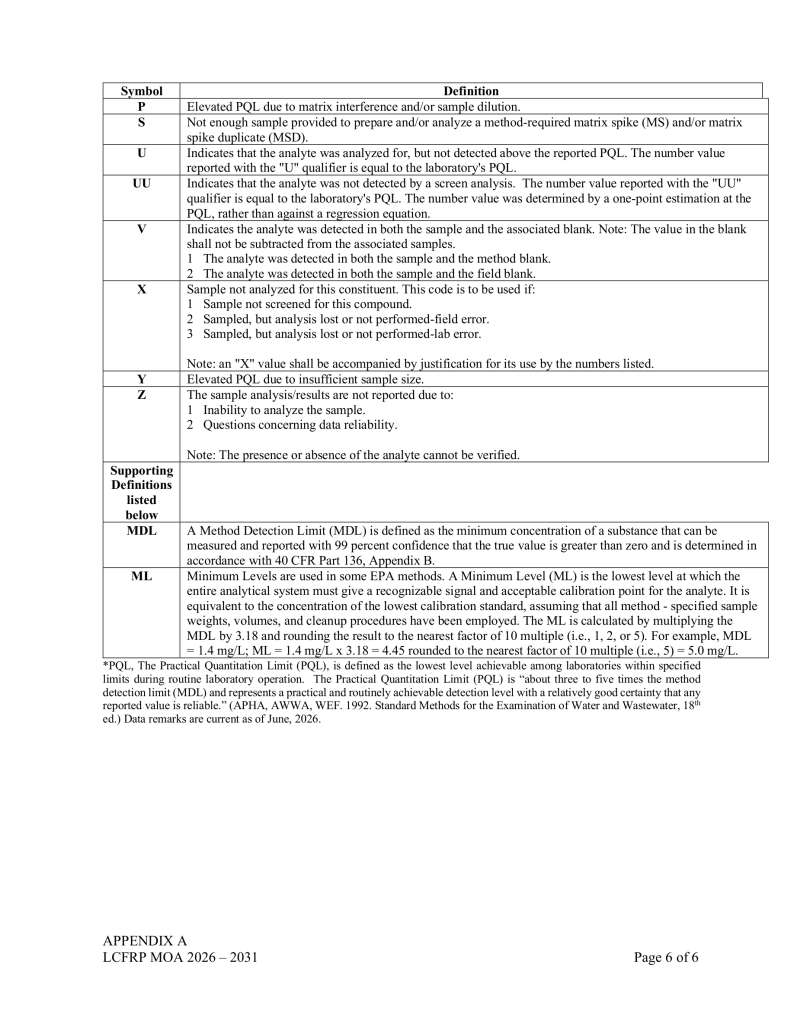
*PQL, The Practical Quantitation Limit (PQL), is defined as the lowest level achievable among laboratories within specified limits during routine laboratory operation. The Practical Quantitation Limit (PQL) is “about three to five times the method detection limit (MDL) and represents a practical and routinely achievable detection level with a relatively good certainty that any reported value is reliable.” (APHA, AWWA, WEF. 1992. Standard Methods for the Examination of Water and Wastewater, 18th ed.) Data remarks are current as of June, 2026.
APPENDIX B
DATA FORMAT AND REPORTING REQUIREMENTS
Data Format for Monthly submittals:
Table 5 provides the format of a data submittal spreadsheet. It is very important that the format of the headings and the number and order of columns is consistent among all monthly submissions. Do not use commas, tabs, or other common file delimiters anywhere in the submittal spreadsheet table. Do not add, delete, or hide any rows or columns. The first row should contain the column headings only. Column headings must include appropriate information on measurement units (e.g., mg/L, µg/L, cfu/100mL, etc.). The second row must contain the method code. The DWR station number (e.g., B6140000) must be provided as identified in the MOA. The comment column is used for describing pertinent information related to the sampling event or specific samples. Ensure that there are no missing values for station, date, time, and depth. Place all remark codes in a separate column, as demonstrated in Table 5. If there is no result for a particular parameter, leave the cell blank. Parameter results shall be a numerical value (integer or floating point) only, any greater or less than results will be indicated by the qualifier code. Delete duplicate rows for stations that were not sampled (e.g., stations sampled twice in summer months). Screen all data for inappropriate or improbable values, such as a pH of 21.2 SU. A data submittal spreadsheet can be provided upon request to the Coalition Coordinator.
Annual Report:
The UCFRBA will be required to submit an annual report by April 30th for each year the MOA is in effect. The annual report will formally summarize all data collection activities in the past calendar year and contain at least the following elements:
- Monitoring Station List to include station number, station description, county, accurate coordinates (in decimal degrees to 4 decimal places), stream classification, and 8-digit hydrologic unit code (HUC).
- List of all certified laboratories that conducted work for the coalition in the past year; identify time frames for all laboratories and analysis methods used during the year; and summarize any laboratory certification issues for individual parameters.
- A list of active LCFRP members with authorized representative updates, contact names, email addresses, and phone numbers. Identify the facility name and permit number.
- A list of members whom became inactive during the year and their permit numbers.
- A summary of all quality assurance and quality control issues and any field audits conducted.
- A summary of any significant issues, special studies, or projects.
- Description of any required data collection that was missed, with an explanation.
- Suggested changes to the monitoring program and/or MOA modifications.
- The LCFRP’s website address.
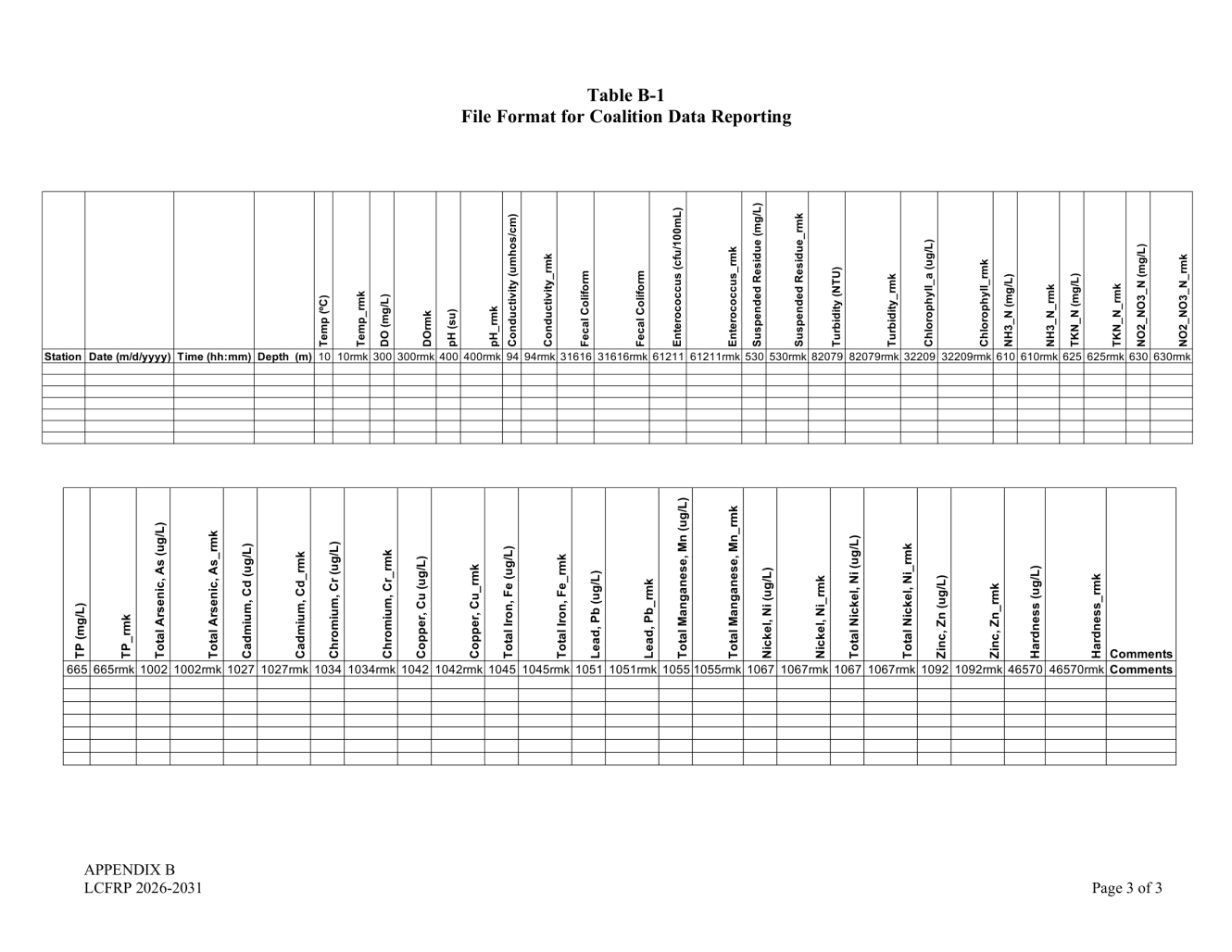
| Station | Date (m/d/yyyy) | Time (hh:mm) | Depth (m) | 10 Temp (ºC) |
10rmk Temp_rmk |
300 DO (mg/L) |
300rmk DOrmk |
400 pH (su) |
400rmk pH_rmk |
94 Conductivity (umhos/cm) |
94rmk Conductivity_rmk |
31616 Fecal Coliform |
31616rmk Fecal Coliform |
61211 Enterococcus (cfu/100mL) |
61211rmk Enterococcus_rmk |
530 Suspended Residue (mg/L) |
530rmk Suspended Residue_rmk |
82079 Turbidity (NTU) |
82079rmk Turbidity_rmk |
32209 Chlorophyll_a (ug/L) |
32209rmk Chlorophyll_rmk |
610 NH3_N (mg/L) |
610rmk NH3_N_rmk |
625 TKN_N (mg/L) |
625rmk TKN_N_rmk |
630 NO2_NO3_N (mg/L) |
630rmk NO2_NO3_N_rmk |
|---|---|---|---|---|---|---|---|---|---|---|---|---|---|---|---|---|---|---|---|---|---|---|---|---|---|---|---|
| 665 TP (mg/L) |
665rmk TP_rmk |
1002 Total Arsenic, As (ug/L) |
1002rmk Total Arsenic, As_rmk |
1027 Cadmium, Cd (ug/L) |
1027rmk Cadmium, Cd_rmk |
1034 Chromium, Cr (ug/L) |
1034rmk Chromium, Cr_rmk |
1042 Copper, Cu (ug/L) |
1042rmk Copper, Cu_rmk |
1045 Total Iron, Fe (ug/L) |
1045rmk Total Iron, Fe_rmk |
1051 Lead, Pb (ug/L) |
1051rmk Lead, Pb_rmk |
1055 Total Manganese, Mn (ug/L) |
1055rmk Total Manganese, Mn_rmk |
1067 Nickel, Ni (ug/L) |
1067rmk Nickel, Ni_rmk |
1067 Total Nickel, Ni (ug/L) |
1067rmk Total Nickel, Ni_rmk |
1092 Zinc, Zn (ug/L) |
1092rmk Zinc, Zn_rmk |
46570 Hardness (ug/L) |
46570rmk Hardness_rmk |
Comments Comments |
|---|---|---|---|---|---|---|---|---|---|---|---|---|---|---|---|---|---|---|---|---|---|---|---|---|