
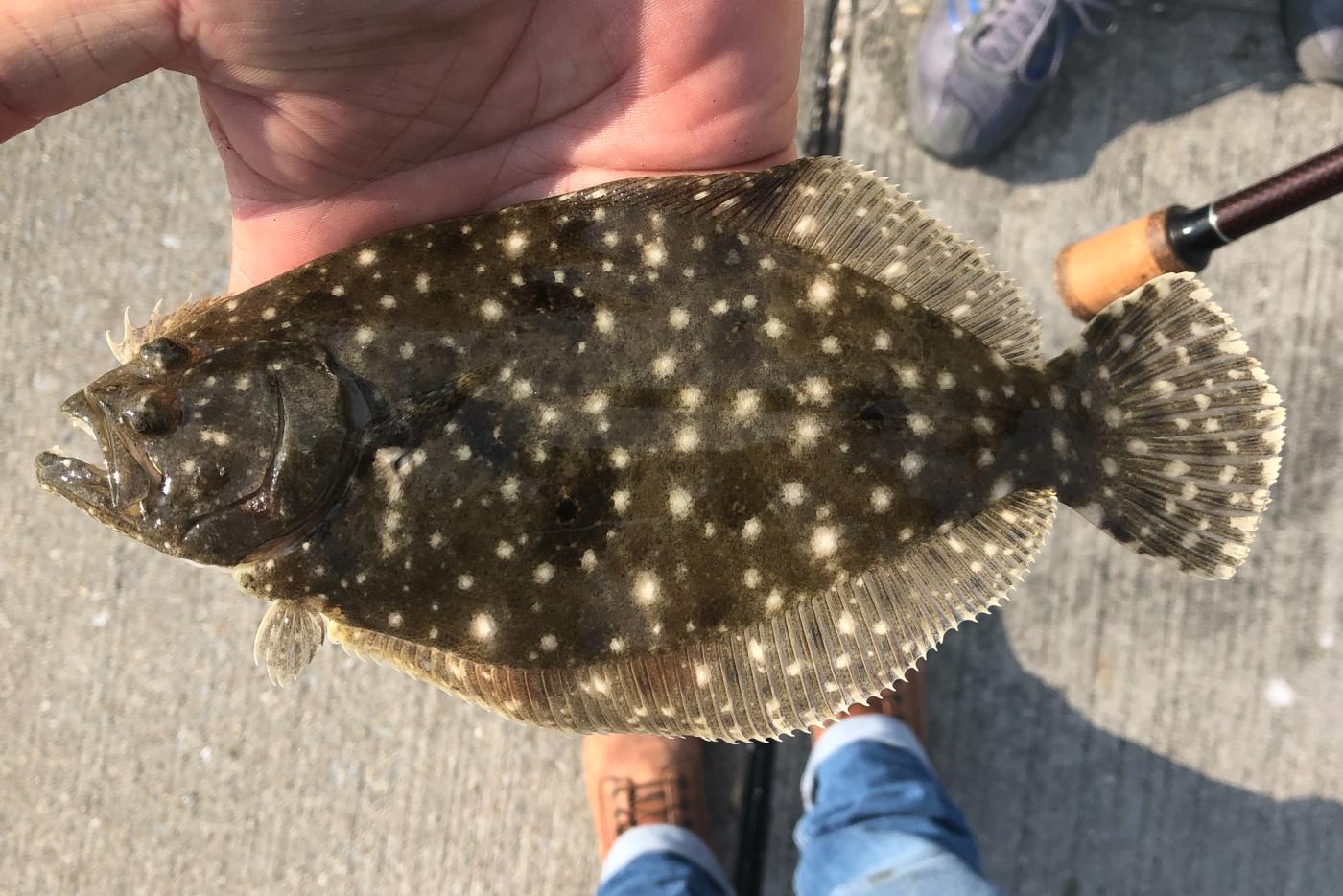
MOREHEAD CITY – The North Carolina Department of Environmental Quality’s Division of Marine Fisheries will open a two-week, spring recreational Gulf Flounder season in ocean waters off the central and southeastern parts of coastal North Carolina.
Season Details:
Dates: March 9–22, 2026
Location: Ocean waters only, from north end of Portsmouth Island (south of Ocracoke Inlet) to the South Carolina line. See map.
Gear: Recreational hook-and-line only
Bag Limit: One fish per person per day
Size Limit: Minimum 15-inch total length
For more specific information, see Proclamation FF-13-2026.
Why these regulations:
Anglers primarily catch three flounder species in North Carolina waters: Southern, Summer and Gulf. Historically, North Carolina has managed all three species as one in the recreational flounder fishery.
The latest stock assessment indicates that Southern Flounder is overfished and overfishing is occurring. Overfished means the population is too small, and overfishing means the removal rate is too high. For this reason, the state has placed strict regulations on flounder to limit Southern Flounder catch.
Amendment 4 to the Southern Flounder Fishery Management Plan does include a provision that allows for a spring recreational Gulf and Summer Flounder season for hook-and-line fishing in the ocean. The spring season was included in the plan to provide recreational fishermen with opportunity to harvest Summer and Gulf Flounder during a time when they are less likely to catch Southern Flounder.
North Carolina cannot open a spring season for Summer Flounder, which is jointly managed by the federal Mid-Atlantic Fishery Management Council and the Atlantic States Marine Fisheries Commission. These entities require that recreational Summer Flounder regulations remain at status quo in 2026 and 2027 based on harvest estimates compared to the recreational harvest limit, and the stock’s biomass estimate compared to the biomass target. This means that North Carolina’s recreational Summer Flounder season in 2026 and 2027 must align with the fall flounder season.
Summer Flounder range in distribution from Massachusetts to Florida but are most abundant from southern New England to Hatteras Island, N.C.
Gulf Flounder range from North Carolina through the Gulf of Mexico. Along the Atlantic Coast, Gulf Flounder become more abundant as you move south.
The Division considered these distribution ranges in choosing the area that will open for harvest of Gulf Flounder while limiting the probability of catching Summer Flounder.
Flounder identification
The Gulf Flounder has the same, familiar flat, rounded body and olive-brown color of other flounders that can change shade depending on the color of the bottom. It has three prominent, ocellated dark spots arranged in a triangle on its eyed side. One spot is above and one is below the lateral line while the third is in the middle of the line towards the tail, forming a triangle. The spots may become obscure in larger fish.
Information on how to identify a Gulf Flounder from a Summer Flounder and a Southern Flounder can be found on the Division’s Flounder Identification webpage. Other information can be found on the Spring Gulf Flounder Season Frequently Asked Questions page.
If there is incidental harvest of Southern Flounder during spring 2026, it will count against the annual quota. Correct identification will be key in minimizing any effects on a future fall flounder season. The Division encourages anglers to release flounder if they are not sure of the species.
Reporting requirements
A new state law requires anglers to report their harvest of flounder, as well as Striped Bass, Spotted Seatrout, Weakfish (gray trout), and Red Drum to the Division. Learn more about this harvest reporting requirement. This reporting requirement does not replace the Marine Recreational Information Program. The Marine Recreational Information Program is still the best available scientific method of collecting recreational fishing information in a representative manner, and anglers are strongly encouraged to participate in the interviews.