
Today, the NC Department of Environmental Quality (DEQ), in partnership with Footprint Project, Land of Sky Regional Council (LOSRC) and NC Sustainable Energy Association (NCSEA), announced the development of two mobile microgrids that will increase resilience during storms. The partnership also showcased critical power and refrigeration microgrid assets.
Mobile microgrids are a collection of solar and battery systems on movable trailers that ensure continued power for communities following extreme weather and during power outages.
Last year, DEQ’s State Energy Office (SEO) announced a $5 million investment in permanent and mobile microgrids to improve disaster resilience. Using these funds, Footprint Project is building two mobile microgrids (trademarked as Beehive Microgrids™) to support community resilience across North Carolina.
At MANNA FoodBank in Mills River, DEQ Secretary Reid Wilson joined coalition partners including Footprint Project CEO Will Heegaard, NCSEA Executive Director Matt Abele, LOSRC’s Sara Nichols and Nathan Ramsey, and MANNA FoodBank COO Elizabeth Hipps to demonstrate the first round of completed assets of the mobile microgrids.
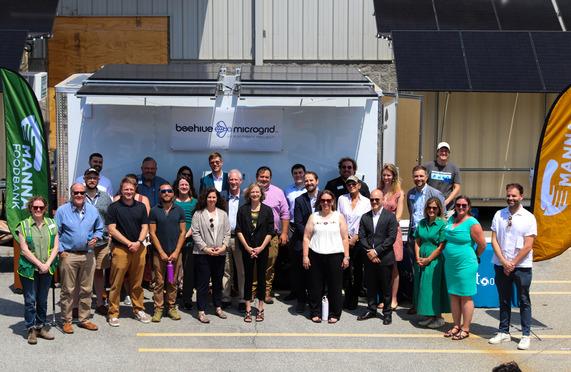
"Western North Carolina communities lost power and communications for weeks following Hurricane Helene. Mobile microgrids help communities get back on their feet faster by providing access to communication networks and providing electricity for critical infrastructure," said DEQ Secretary Reid Wilson. "The two mobile microgrids will be able to be deployed statewide to help communities recover more quickly after major disasters."
“Beehive Microgrids™ are made up of an ecosystem of solar and battery systems on towable trailers that provide a range of services,” said Heegaard. “Cooler Bees include fridges and freezers and can store food, medicine, and ice. Power Bees charge electronic devices, medical equipment, and portions of entire buildings, and Water Bees provide drinking water filtration. Because they are mobile, these Bees can be towed immediately to communities hardest hit in disasters.”
“Helene made clear that resilience is not abstract — it is whether people can keep medicine cold, charge a phone, access information, power essential services, and support their neighbors during a crisis,” said Nichols. “The Beehive Microgrids give Western North Carolina a flexible, mobile tool to meet those needs when traditional systems are disrupted. Land of Sky Regional Council is proud to be part of this partnership and to help build a more prepared, connected, and resilient region.”
"As we saw after Helene, solar and battery storage served an invaluable role in keeping the lights on for many throughout the region,” said Matt Abele, with the North Carolina Sustainable Energy Association. “Continued investments in this technology are instrumental for long-term resiliency, and to ensure North Carolina is better prepared for future storms and other grid events.”
These two mobile microgrids will be fully completed in March 2027 and will consist of solar and battery powered trailers for refrigeration and electricity, for longer term disaster recovery efforts.
Permanent microgrid projects also in progress
As part of this initiative, the coalition will also install up to 24 permanent microgrids across six Hurricane Helene-affected counties: Avery, Buncombe, Madison, Mitchell, Rutherford, and Yancey.
Selected sites will receive stationary microgrids to ensure continuity of operations during future disasters, offset the sites' energy costs and contribute clean, reliable energy to the grid during normal conditions. Following a request for proposal process, the coalition selected the first 5 sites to receive microgrids:
- East Asheville Library in Buncombe County – The coalition will install a 120-kWh battery to support the existing solar array. This heavily used public library served as a vital resource after Hurricane Helene, providing food and water distribution, internet access, and a disaster recovery center. The project amount is $199,850.
- Beacon of Hope in Madison County – The coalition will install a 32.16 kW solar array and 67.5 kWh battery. Beacon of Hope operates as a critical food distribution hub supporting underserved communities. The project amount is $102,702.
- Buladean Community Center in Mitchell County – The coalition will install a 48.4 kW solar array and 80 kWh battery. The center serves as a designated shelter and emergency coordination site during crises, supporting residents with essential services and gathering space. The project amount is $211,226.
- Bill’s Creek Community Center in Rutherford County – The coalition will install an 8.7 kW solar array and 27 kWh battery. This rural community center located in the Lake Lure area supports hundreds of North Carolina families, many of whom lack access to public water or sewer services. The center also provides free medical supplies through the medical equipment loan closet. The project amount is $55,063.
- Burnsville Fire Department in Yancey County – The coalition will install a 39.96 kW solar array and 80 kWh battery. During Hurricane Helene, this site served as a critical base for search‑and‑rescue operations, helicopter landings for accessing remote areas, and a field hospital staffed by volunteer medical personnel. The facility also operated as a major distribution center for donated supplies. The project amount is $183,572.
Microgrid installations will begin this summer, and DEQ will continue site selection throughout 2026.
This innovative disaster recovery model will strengthen emergency power access for critical community services, serving thousands of North Carolinians.