
The Gold Era in NC
The United States had not been a player in industrialized gold mining until a fateful Sunday in 1799 when a 12-year-old boy in Cabarrus County found a 17-pound, shiny nugget in a creek on his family's farm. The discovery of that gold nugget, and the subsequent word of mouth that spread throughout the region, triggered the first gold rush in the U.S. and forever changed the history of our nation. The history of gold mining in North Carolina is a great story of industrialization and agriculture and how the two struck a balance in the early years of gold fever in a very rural state. Currently, there are no major commercial gold mining operations in North Carolina but new mining technologies and renewed interest in our high-tech society could change that.
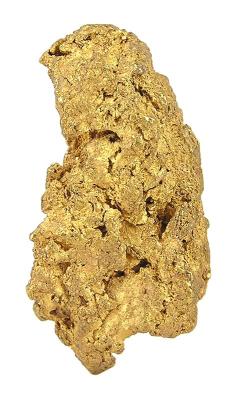
The NC Geological Survey has two interactive ESRI StoryMaps regarding gold - the history of gold itself and the history of gold in North Carolina. They're great resources for students, educators, and all interested citizens!
The Gold Standard Gold in North Carolina
A Little Bit of History
The central Piedmont of NC in the 1700s and early 1800s was rural farmland, inhabited by the Catawba Native Americans and European settlers but the Revolutionary War and discovery of gold would drastically change this landscape, figuratively and literally. Once word got out that gold had been found on the Reed farm in Cabarrus County, prospecting spread from farm to farm, county to county, and southern state to southern state.
Quick Facts
- Native Americans in Cherokee County may have been mining gold before the arrival of European settlers
- Unsubstantiated reports claim that in 1540, Spanish explorer Hernando de Soto attempted to mine gold along the Valley River near Murphy, NC
- North Carolina was the only gold-producing state in the U.S. from 1803-1828; most of the gold mining during this time was placer mining (panning in creeks and streams)
- By 1830, the leading mines in North Carolina were hard-rock mines rather than surface placer operations
- A branch of the U.S. Mint was opened in Charlotte in 1837; this Mint coined nearly $5 million worth of southern gold in $1, $2.50, and $5.00 denominations. Minting continued here until the start of the Civil War in 1861.
- North Carolina was the leading producer of gold in the U.S. until 1848 when gold was discovered in California
- Sporadic gold production occurred in North Carolina until the early 1900s. The last significant gold production between 1954 and 1963 was actually a byproduct of copper mining in the Blue Ridge Mountains
Gold Occurrence and Mining in NC
Gold is widely distributed in small amounts in North Carolina's igneous rocks and occurs in both lode (veins or mineralized zones) and placer (stream sediment or residual) deposits. The Piedmont and Mountain regions of North Carolina are full of igneous rocks with quartz veins, where gold tends to be deposited.
Piedmont
At the height of the gold rush, there were more than 250 gold mines in operation in the Piedmont. Most early production was in the central Piedmont, particularly in the area formerly known as the Carolina Slate Belt and in Mecklenburg County. This area includes the Gold Hill and Cid Mining districts, the Reed Mine in Cabarrus County, the Gold Hill Mine in Rowan County, and the Silver Hill Mine in Davidson County. Overall, the most productive Piedmont mines were found in the following counties: Guilford, Randolph, Davidson, Rowan, Montgomery, Stanly, Cabarrus, Mecklenburg, and Union. Mecklenburg County had more mines and gold prospects than any other county in the State. The most important mines in Mecklenburg County were the Capps, Rudisil and St. Catherine Mines.
Mountains
In the Mountain region, mines and prospects were located in Ashe, Buncombe, Cherokee, Clay, Henderson, Jackson, Transylvania and Watauga Counties. Copper mines in Ashe and Swain Counties produced byproduct gold
Reed Gold Mine
It's generally accepted that the Reed family farm was the location of the first documented gold discovery in the U.S. The story of the Reed Gold Mine has been told many times, so rather than reinvent the wheel, we're going to steer you to some great resources, including our interactive Gold in North Carolina Storymap and the Reed Gold Mine State Historic Site website.
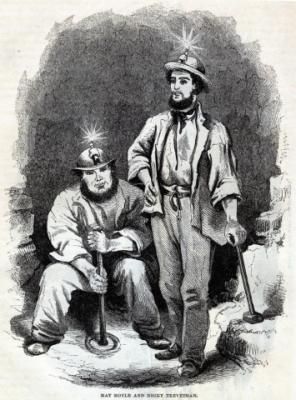
Writer and Illustrator Porte Crayon visited Gold Hill in 1857 for Harper's New Monthly Magazine and created the best surviving images of antebellum Carolina mining. All images below are courtesy of N.C. Historic Site, Division of Archives and History.
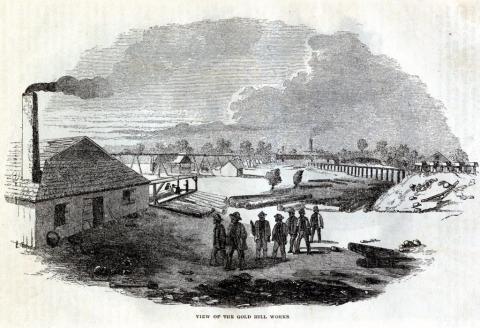
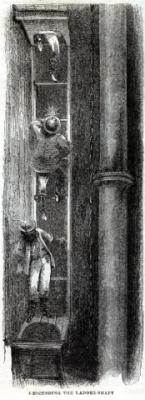
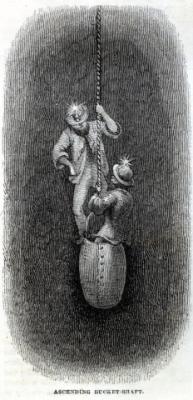
Reed Gold Mine State Historic Site
A tour of the place where gold was first discovered in the U.S. - the Reed Gold Mine State Historic Site, Midland NC.
Gold FAQs
If you aren't sure it's gold, it probably isn't! Pyrite and yellow-colored mica are frequently mistaken for gold, but can easily be distinguished. Gold is very soft (2.5-3 on Mohs scale of hardness) and can be hammered into thin sheets without shattering. It is heavy (specific gravity of 19.3 when pure) and is insoluble in all acids except aqua regia (a mixture of hydrochloric and nitric acids).
Pyrite is harder than gold (6-6.5 on Mohs scale) and is brittle. When struck with a hammer, it shatters. It is also relatively light (specific gravity of 5.02). Pyrite frequently forms small cubes. Mica, on the other hand, is as soft as gold (hardness 2-2.5), but naturally occurs in thin sheets or flakes that can be split into individual sheets. It is lighter than gold (specific gravity of 2.76-3.1) and can be smeared out with a fingernail or a sharp object.
Most property in North Carolina is privately owned. Individuals interested in non-commercial prospecting should obtain permission from the landowner prior to entering private property. Most landowners are cooperative, but do not tolerate trespassers.
For serious mining, a lease agreement or purchase of mineral rights can be negotiated with the landowner. Unless bought separately, mineral rights are normally retained by the landowner. Property deeds are recorded in courthouses in the county seat of each county. These records can be examined to determine land ownership.
Most federal lands in North Carolina are in parks and forests. Although prospecting is not permitted in national parks, prospecting or exploration permits are occasionally granted in national forests. The district forest ranger should be contacted for permits and regulations. Prospecting is not allowed in state-owned parks or forests.
Any mining must be carried out in accordance with the North Carolina Mining Act of 1971. Anyone operating a mine that affects more than one acre of surface area must obtain a permit, post a bond, and develop a reclamation program. Further information is available from the Land Quality Section of the Division of Land Resources, 1612 Mail Service Center, Raleigh, North Carolina 27699-1612, telephone (919) 707-9220.
All mining operations must comply with state and federal laws pertaining to safety and health requirements. Prior to opening a mine, operators should contact the Mine and Quarry Division of the North Carolina Department of Labor, 4 West Edenton Street, Raleigh, NC 27601, telephone (919) 807-2790 or (800) LABORNC (522-6762).
Most of the gold-exploration companies in North Carolina are looking for invisible gold associated with volcanic rocks. Amateur prospectors are looking for the coarser gold found in streams and quartz veins. Streams flowing through former gold-producing districts offer the best opportunities for panning. Although these streams were prospected many times, much of the fine gold was lost during earlier activities. Because stream action and erosion redistributed the gold, it is still possible to find small amounts of gold in the stream sediments (placers). It is also possible to find gold in quartz veins exposed at the surface of the ground. Although there are many quartz veins, it is rare to find one that contains gold.
The best place to find gold in streams is where they begin to widen or change in velocity, such as along the insides of bends or in slow-water areas below rapids. Gold also tends to work its way to the bedrock and often accumulates in crevices, depressions, and potholes in rock underlying the streams.
Streams such as Little Buffalo Creek in Rowan and Cabarrus Counties, Dutch Buffalo Creek in Cabarrus County, Cabin Creek in Moore County, the Uwharrie River in Montgomery County and streams in the South Mountain area might be good places to try panning. The Cotton Patch Mine near New London, Stanly County, is open to the public for panning. For a fee, gold seekers can pan from sediments dug from a small creek.