
School and Group Field trips
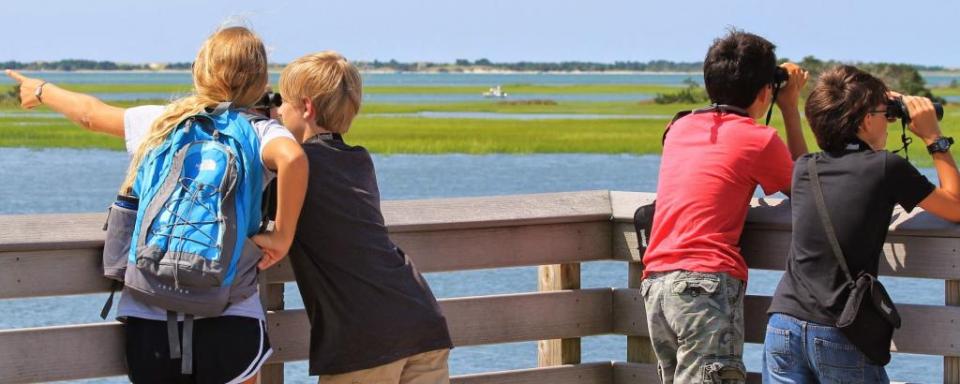
Island Explorers Program at the Masonboro Island Reserve
The Masonboro Island Reserve is involved in a pilot program called Masonboro Island Explorers for fifth-grade students in New Hanover County. The program is a partnership between the Reserve and Masonboro.org, a non-profit promoting responsible use of Masonboro Island, and is based on a field trip Masonboro.org led for Wrightsville Beach Elementary fifth graders in Fall 2013. The Island Explorers program also incorporates many of the curriculum elements found in the Beaufort-based field trips to the Rachel Carson Reserve, and Reserve educators will develop pre-and post-trip activities and teacher training as the program develops. Masonboro.org has kindly organized many of the trip logistics and will provide boat transportation for the students to reach Masonboro Island for the field trip. For many, the boat ride and field trip will be their first experience exploring estuarine and barrier island habitats, and both partners hope to inspire students to continue learning about the natural world in Wilmington and beyond!
Rachel Carson Reserve Field Trips
The Reserve's Education Coordinator leads two different types of field trips on the Rachel Carson Reserve in Beaufort. We offer a 2-hour, guided nature hike across the western end of the island and a 2-hour boat ride with a short visit to our boardwalk at the east end of the island. Both trips require reservations at least two weeks in advance. Information about the different field trips is given below.
To schedule a guided field trip please contact Education Coordinator, Lori Davis, at 252-838-0883.
Scheduling
Guided walking field trips by Reserve educators are subject to staff availability and low tides. Education staff will provide you with several suitable dates when you call or email to ensure availability and proper tides. Notify the staff of your instructional objectives as some activities require greater teacher preparation.
Student walking field trips are scheduled Monday through Friday from April 1 - October 31 on a first come, first served basis. The maximum number of individuals (including teachers and chaperones) that we can accommodate on the Reserve at any one time is limited to 45. Transportation to the island can be done by our boat (free of charge) with our U.S. Coast Guard Certified boat captain or by one of the ferry services on Front Street in Beaufort.
Required Attire
Closed-toe shoes are required for all participants. All participants (students, teachers and chaperones) must wear a life jacket (provided) while on the boat. Wear old clothes suitable for getting wet and muddy. Dress appropriately for the weather. Sunscreen, hats and bottled water are highly recommended. Windbreakers may be necessary during the spring and fall as the site can be considerably windy.
What You Can Expect
A walking field trip to the estuary can easily be incorporated into your curriculum as many North Carolina curricular objectives in science, social studies, and language arts are addressed.
After a short boat ride to the Rachel Carson site, the interpretive walk begins at a salt panne, where the water comes in on the high tide and is trapped as the tide recedes. As the water evaporates, the salinity in the salt panne may reach 45 ppt (parts per thousand), whereas the ocean is usually 35 ppt. The marsh begins at the edge of the panne. Here students can identify plants such as salt marsh cordgrass, sea ox-eye, sea lavender, glasswort, and black needle rush. The walk across the dredge-spoil island exposes students to dune colonization by sea oats and plant succession, including wild asparagus and Spanish Bayonet. When students emerge onto the tidal flat they find a new wealth of flora and fauna.
In addition, students gain new understanding that an estuary can be a tough place to live. With tidal action causing great variation in temperature, turbidity, water depth and salinity, the plants and animals that live in this world have adapted and learned to use this variety to their advantage. For example, blue crabs need high salinity for their eggs to hatch and the juvenile crabs to develop, so they move to areas that meet those needs. Yet adults flourish in lower salinity, so you will find the largest crabs in less saline areas of the estuary. Other animals use the shallow waters of the marsh and mudflat to hide from larger predators. Periwinkles, vegetarian snails that feed on algae growing on the mud and salt marsh grasses, crawl up the grass stems as the tide comes in to escape being eaten by the fish and crabs that come in with the tide.
The excursion around the island gives students the chance to investigate the effects of feral horses living on an estuarine island. Students can learn how the horses search out water and food, and how they have adapted to the environment. This study is particularly valuable for high school biology objectives.
Given sufficient time, groups proceed across a tidal flat to Bird Shoals, which are mostly covered at high tide. These large expanses of shallow sound beach, located directly inside Beaufort Inlet between Bogue Banks and Shackleford Banks, offer students an excellent area for finding sandy bottom dwellers.Locating sand dollars, both shell-remains and living, is exciting for all ages. In addition, students often discover live cockles, scallops, tube worms, horseshoe crabs and fish. Occasionally live rays, egg cases of whelks and other shelled mollusks, worms, and skates can be found.
The trip will continue by following the horse trails across the island, allowing groups to see the effect of salt spray on the canopy. The shrub thicket includes live oak, red cedar, wax myrtle, and toothache trees, along with a variety of other plants that have taken root in the dredge-spoil of times past. Emerging back on Taylor's Creek, students will walk along another salt marsh/ mudflat to return to the boat pick-up point.
After completing the field experience, students should be able to:
- Describe an estuary.
- Explain the causes and diversity of conditions in an estuarine system.
- Compare and contrast the lifestyle of two invertebrates living on a tidal flat.
- Draw a food web of estuarine animals.
- Describe the ecological sensitivity of an estuarine system.
- Debate the roles of the horse population on the island.
Our staff looks forward to helping your group have a successful, memorable and educational field
experience at the Rachel Carson Reserve.
Scheduling
Guided boat/boardwalk field trips by Reserve educators are subject to staff availability and low tides. Education staff will provide you with several suitable dates when you call or email to ensure availability and proper tides. Notify the staff of your instructional objectives as some activities require greater teacher preparation. Field trips are scheduled Tuesday through Friday from April 1 - October 31. Boating field trips are limited to 15 people total including teachers/chaperones.
Required Attire
Closed-toe shoes are required for all participants. All participants (students, teachers and chaperones) must wear a life jacket (provided) while on the boat. Wear old clothes suitable for getting wet and muddy. Dress appropriately for the weather. Sunscreen, hats and bottled water are highly recommended. Windbreakers may be necessary during the spring and fall as the site can be considerably windy.
What You Can Expect
A boat ride field trip to the estuary can easily be incorporated into your curriculum as many North Carolina curricular objectives in science, social studies, and language arts are addressed.
After leaving the dock, the boat ride begins with a discussion about the Rachel Carson Reserve, Rachel Carson and estuary basics. As the boat travels down Taylor's Creek, students will have a waterside view of Town Marsh and a couple of the Reserve's habitats starting with a salt panne, where the water comes in on the high tide and is trapped as the tide recedes. The salt marsh begins at the edge of the panne and includes plants such as salt marsh cordgrass, sea ox-eye, sea lavender, glasswort and black needle rush.The excursion continues down Taylor's Creek giving students an opportunity to observe some of the birds that make the Rachel Carson Reserve their home. More than 200 species of birds have been observed at this site, which is located within the Atlantic flyway. Twenty-three species are considered rare or decreasing in number. Participants might even get lucky enough to catch a glimpse of the feral horses or bottle-nosed dolphin.
After stepping onto the boardwalk, students will experience marsh and successional dredge spoil habitats, along with a diverse array of plant and wildlife species with minimal impact to the site. Informational displays along the way will highlight interesting facts about the surrounding flora and
fauna.
The trip will continue with a boat ride back up Taylor's Creek or along the south side of the island depending on the weather and the tide.
After completing the field experience, students should be able to:
- Describe an estuary.
- Compare and contrast three different estuarine habitats.
- Compare and contrast three different coastal fish habitats.
- Describe the ecological sensitivity of an estuarine system.
- Debate the roles of the horse population on the island.
- Be familiar with Rachel Carson and her influence on the environment.
Our staff looks forward to helping your group have a successful, memorable and educational field
experience at the Rachel Carson Reserve.