
DEQ – NC Collaboratory Applied Science Fellowship


In July 2022, DEQ and the NC Collaboratory launched a pilot fellowship program to strengthen partnerships between academic researchers and state environmental regulators. The program, now known as the DEQ – NC Collaboratory Applied Research Fellowship, provides selected researchers with opportunities to assist DEQ in identifying, monitoring, and analyzing environmental contaminants with a focus on Per- and Polyfluoroalkyl Substances (PFAS).
The pilot fellowship program placed four academic researchers within DEQ offices and laboratories. Based on strong positive feedback from participants and agency leadership, the fellowship is now offered annually.
The goals of this annual fellowship program are to:
1. Establish long-term research partnerships between State regulators, policymakers, and academic research experts.
2. Generate, review, and analyze PFAS-related data, including compound type, concentration, location, and environmental media.
3. Identify and address DEQ’s most pressing PFAS issues using research-based solutions.
4. Build workforce and knowledge capacity in research-practice partnerships.
Eligibility: Eligible applicants can be based at any North Carolina institution of higher education and may include:
• Faculty
• Research scientists
• Postdoctoral research scholars
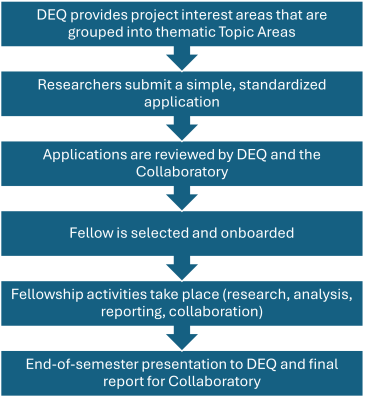
DEQ:
- Identify priority research needs
- Host fellows in divisions and labs
- Provide mentorship and data access
- Participate in review and evaluation
NC Collaboratory:
- Coordinate application and funding processes
- Connect researchers with available resources
- Support program evaluation and reporting
Fellows:
- Conduct research aligned with DEQ priorities
- Produce deliverables defined at project start
- Participate in meetings, presentations, and cross-agency collaboration
- Generate performance/financial reports for Collaboratory
Jamie DeWitt – Toxicology
Dr DeWitt assisted DEQ in compiling existing state-level PFAS regulations and detailing the toxicological underpinning the regulations were based on. Dr DeWitt supported the ongoing evaluation of toxicological literature to support DEQ’s rulemaking, public communication, and chemical prioritization. The knowledge transfer that occurred between DEQ and Dr DeWitt helped both understand where and how scientific studies and publications support regulations and better understand the time it takes to publish student’s work and the additional work that can be required to support publication of studies after a student has moved on to another institution.

Seeking Clean Water | East Magazine | ECU
Lee Ferguson – Analytical Chemistry
Dr Ferguson assisted the DEQ Chemistry lab in the installation and set-up of new PFAS analytical equipment. The knowledge transfer between Dr Ferguson and the DEQ staff was invaluable. Dr Ferguson also contributed to administrative meetings in setting priorities for environmental investigations in potentially contaminated areas with emerging PFAS compounds. Dr Ferguson helped DEQ better understand the intricacies of fluorinated compounds that may not be PFAS but add to the environmental contamination of PFAS compounds. This information has been used to support the forthcoming updated permit requirements for PFAS sampling and reporting.

Duke Researcher Strives to Keep ‘Forever Chemicals’ Out of North Carolina Water Supply | Duke Today
Ralph Mead – Fate & Transport
Dr. Mead assisted DEQ’s DAQ with the analysis and interpretation of near-field deposition data from the Chemours Fayetteville Works facility. He examined seasonal variation, differences in wet and dry deposition suites of PFAS compounds and provided a basis for the data that is continually being collected. Dr. Mead also compared this data with the data collected from direct emissions from the facility, which has improved DEQ’s understanding of emissions leaving the facility and deposited into the environment.

Detlef Knappe
Dr. Knappe’s interest in multimedia impacts of emissions and waste from Fayetteville Works was the basis for his work at DEQ and helped shape his lab’s analytical method development. The fellowship project at DEQ led to a follow-up project performing non-targeted analyses of air emissions samples collected from the facility as well as process wastewater and leachate from a landfill that had received solid waste from Fayetteville Works. The results provide new insights into the types of PFAS associated with the site.

Dave Genereux – Fate & Transport
Dr Genereux assisted DEQ in efforts to better understand PFAS plume persistence in the Cape Fear River watershed near Fayetteville and Wilmington, NC. Applying his convolutional modeling and groundwater age dating methods to estimate contaminant presence and persistence in groundwater. Dr. Genereux is also helping the Department better understand the role of ultrashort chain on total PFAS mass released into the environment. These efforts will help inform long-term goals for understanding and managing PFAS releases in the Cape Fear River basin.
