
Winter II 2025
In this issue:
Grantee Spotlight: Reeder Pallet - New BPI Commercial and Home Compostability Certification
- NC Grant Programs Offer Opportunity for Collaboration With Local Governments
- Partnership in Action: Valdese and Simply Green Strengthen Local Recycling
- Preparing North Carolinas Battery Landscape for 2026
- Professional Development Opportunities
- Market Pricing Update
Grantee Spotlight: Reeder Pallet
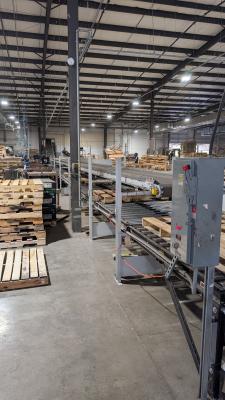
With support from Recycling Business Development grant funding, Reeder Pallet installed a new conveyor system as part of a relocation into a new facility. This conveyor system eliminated the use of forklift-hauled hoppers full of wood waste, instead efficiently conveying wood waste directly into their grinder, streamlining material flow and increasing productivity. “The conveyor system has completely eliminated the need for scrap waste hoppers and has seamlessly been adopted into our new facility. Our forklift drivers are much more efficient now, with the ability to stay within their work zones and no longer navigating to the grinder to empty hoppers,” said Matthew Reeder. Comparing the last full quarter at the old facility to the first full quarter at the new one, pallets processed increased from 118,658 to 135,135, production hours worked rose from 7,755.5 to 8,058.5, and productivity per hour jumped from 15.3 to 16.77, a 9.6% increase in efficiency.
These gains are directly supporting Reeder Pallet’s ability to handle and recycle more wood materials in North Carolina. With the improved workflow made possible by the conveyor system, the company now has the capacity to grow pallet-processing volume by at least one-third without additional equipment investment, supporting job growth, operational stability, and increased diversion of wood waste from disposal. Reeder Pallet has set a goal of doubling its output by 2030, positioning itself as a growing contributor to North Carolina’s circular, wood-materials economy. Visit Reeder Pallet’s website to see product offerings or to get connected with their team.
Organics Recycling Spotlight: BPI Launches Commercial & Home Compostability Certification
The Biodegradable Product Institute (BPI) announced its new Commercial and Home Compostable Certification program that identifies products that break down in home compost piles at lower temperatures. This certification is relevant for manufacturers of compostable products seeking to meet growing demand for verifiable end-of-life solutions, and for haulers and processors aiming to streamline contamination-free organics collection.
Check out BPI’s additional educational resources for the program.
NC Grant Programs Offer Opportunity for Collaboration with Local Governments
Public-private partnerships can invigorate the local circular economy—and building momentum can start with a spark of funding. Below are two grant opportunities available exclusively to NC local governments, but they present a valuable chance for recycling businesses to collaborate with municipalities on innovative, impactful projects.
Community Recycling Grant Reminder
Proposals are now being accepted for the 2026 Community Waste Reduction and Recycling (CWRAR) Grant Program.
This grant program is a recurring annual funding opportunity for local governments to build lasting capacity to divert materials from the waste stream and / or increase public awareness of recycling. Proposals are due by 5:00 p.m. on Friday, February 13, 2026.
For more information or assistance, please contact Alex Miller at 919-707-8190
Helene Recovery Recycling Infrastructure Grant
With funding provided by the EPA, The North Carolina Department of Environmental Quality (NCDEQ) has launched the Helene Recovery Recycling Infrastructure grant program. Twenty-five million dollars is available to local governments in areas impacted by Hurricane Helene for projects aimed at rebuilding and strengthen recycling and composting infrastructure. Local governments within FEMA-declared disaster counties may apply for up to $5 million per project, with no local match required.
Proposals are due by 5:00 p.m. on Friday, February 13, 2026.
For more information or assistance, please contact Matt James at 919-707-8142 or at Matt.James@deq.nc.gov
From partnerships like UNC Wilmington’s food waste collection program with local haulers, to county-led yard waste recycling initiatives supported by private processors, North Carolina has a strong track record of public-private success. Please pass these opportunities along to your municipal contacts—or consider how your organization might team up to bring these projects to life.
Partnership in Action: Valdese and Simply Green Strengthen Local Recycling
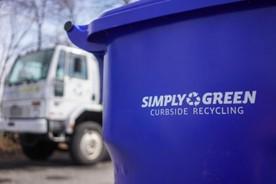
In July of 2025, the Town of Valdese in Burke County began offering waste services through a new partnership with Simply Green Recycling & Waste. This collaboration grew out of a shared desire to increase service quality, reduce costs, and improve the long-term sustainability of the town’s recycling program.
By working together, the Town and Simply Green created a model for how public-private partnerships can deliver mutual benefits. Simply Green recommended that Valdese purchase and provide its own recycling carts, helping the Town gain more control over its program and reduce long-term costs. With $30,000 in grant funding from NCDEQ, Valdese distributed 1,750 new carts, saving about $24,000 annually in rental fees.
To further strengthen the partnership, Simply Green introduced trash collection as a service offering, enabling the Town to streamline operations under one provider. This project demonstrates how flexible, well-coordinated collaboration between the public and private sectors can lead to smarter, more sustainable waste management solutions. Visit Simply Green’s website to learn more about their company and services..
Preparing North Carolina’s Battery Landscape for 2026
The NCDEQ is actively collaborating with partners statewide to prepare for the upcoming December 1, 2026 ban on landfilling lithium-ion batteries. The ban was enacted in October 2023, in response to a rising number of fires at waste facilities caused by damaged lithium-ion batteries, along with growing concerns about human safety and environmental health. This policy shift is expected to significantly impact material flows, market demand, and safety practices across multiple industries
Following regional meetings with over 70 local governments, NCDEQ recently convened private-sector stakeholders—including battery recyclers, materials recovery facilities (MRFs), and service providers—to evaluate the state’s recycling capacity and identify key needs from the business community. These discussions highlighted the urgent need for stronger battery collection networks, clearer guidance on packaging and transport, improved coordination to reduce fire and safety risks.
These insights are helping NCDEQ align public and private efforts to create a safer, more efficient battery recovery system—one that not only protects workers and facilities but also supports emerging market opportunities. To support this transition, NCDEQ is developing a new lithium-ion battery webpage to share updates and gather public feedback.
Looking ahead, the Division of Environmental Assistance and Customer Service (DEACS) will continue stakeholder engagement and resource development throughout 2026.
SMARTERNC: Supporting Smart Manufacturing in North Carolina
The North Carolina Department of Commerce (NCDOC) and NC State University (NCSU) recently launched SMARTERNC with funding provided by the U.S. Department of Energy (DOE). The federal grant program is designed to support small-to-medium sized manufacturers in North Carolina that are interested in adopting smart manufacturing technologies.
SMARTERNC aims to help manufacturers improve efficiency, productivity, and energy performance through the integration of smart technologies. These upgrades can enhance monitoring capabilities, increase accuracy, and automate complex processes. In the long term, smart manufacturing can also lead to significant cost savings. For example, predictive maintenance tools can allow facilities to monitor equipment performance and detect potential issues before they become costly problems.
Eligible manufacturers working with recycled materials including but not limited to fiber and yarn, compost, pulp, pallets and paper, or engineered wood may qualify for up to $25,000 in financial assistance, with a required 30% matching contribution.
Small-to-medium-sized manufacturers in North Carolina can begin by completing a short application to determine eligibility.
To learn more or apply, please visit the SMARTERNC webpage.
Professional Development
Conference: Carolina Recycling Association 36th Annual Conference and Trade Show March 16-19, 2026: Embassy Suites by Hilton Myrtle Beach Oceanfront Resort at Kingston Plantation - Conference: Textiles Recycling Expo USA | April 29-30, 2026 Charlotte, North Carolina Registration Opens Soon
- Conference: 2026 ReFED Food Waste Solutions Summit (May 19-21, 2026, The Westin Charlotte, Charlotte, NC
- Conference: CDRA Conference & Trade Show (January 27-January 30, Saddlebrook Resort, Tampa Florida) Registration open now