
Recycling Works Recent Editions
2026
In this issue:
- Grantee Spotlight: Garbage Pal Increases Recycling Capacity Tenfold
- 2026 Grant Recipients Announced for RBDG and FWRG
- NC Recycling Business Employment Survey
- Recycling in Action Month
- Best Practices for Rolling Out Recycling Curbside Collections
- Professional Development Opportunities
Grantee Spotlight: Garbage Pal Increases Material Recycling Capacity Tenfold
Garbage Pal, a recycling and waste management company based in Fletcher, NC, recently enhanced its cardboard processing operations with support from a 2024 Recycling Business Development Grant from the North Carolina Department of Environmental Quality (DEQ). The grant funded the purchase of a Bramidan 6030X baler. This upgrade streamlined material handling, increased operational capacity, and created two new staff positions in the company, allowing the company to increase material recovery and improve landfill diversion rates.
“The grant-funded cardboard baler has helped us significantly improve our recycling efforts. It has supported job creation through expanded processing operations and generated economic value by reducing disposal costs, strengthening the local recycling market,” said Jared Brenemen, owner of Garbage Pal. “We appreciate the state’s support in advancing both environmental and economic outcomes.”
Since installing the baler, Garbage Pal has increased cardboard recycling tenfold, from 45 tons annually to approximately 576 tons per year, averaging close to 10 bales per operational day. The increase in capacity allowed Garbage Pal to take on new customers and uniquely positioned the company to help manage the influx of cardboard that came to the region in the months following Hurricane Helene. The improvements resulting from this project support Garbage Pal’s ability to handle larger volumes of cardboard, reduce transportation-related costs, and strengthen North Carolina’s local recycling market.
2026 Grant Recipients Announced for RBDG and FWRG
We’re excited to share that recipients have been selected for the 2026 Recycling Business Development Grant (RBDG) and Food Waste Reduction Grant (FWRG) programs.
This year, RBDG received 33 applications, with 12 projects selected for funding. The awards total $494,500 and are expected to leverage an additional $1.4 million in private matching investment. Selected projects include a mix of recycling infrastructure investments, including C&D recycling, solar panel and lithium-ion battery recycling, and MRF upgrades. These projects are expected to strengthen North Carolina’s in-state recycling capacity and divert an additional 18,000 tons annually.
For FWRG, 11 grants were awarded from 28 applications, totaling $483,000 and leveraging $517,353 in matching funds. Funded projects support com
posting operations, food rescue organizations, and organics haulers, and are expected to divert 1,144 tons from disposal while providing 546,750 meals through rescued food. The selected grantees serve a diverse mix of communities across the state, including rural, suburban, and urban counties.
Together, these projects represent practical, on-the-ground investments that support North Carolina’s recycling and materials management systems.
Recycling Business Development Grant Information
NC Recycling Business Employment Survey
Are you a North Carolina-based recycling hauler, processor, broker, or manufacturer using recycled feedstock? The Recycling Business Assistance Center (RBAC) needs your response to the 2026 Recycling Employment Survey.
The 2026 N.C. Recycling Business Employment Survey will help determine how many people are employed by recycling businesses across the state. Data collected from responses will be used by RBAC to demonstrate the economic value of recycling.
Insights from this survey will inform a RBAC report detailing employment trends in the state’s recycling industry, to be published later this year. The last such report came out in 2020 and found that the industry supported 15,700 jobs and generated an annual payroll of $759 million.
This data is crucial for DEQ to properly allocate funding and resources to support the state’s circular economy. Responses are confidential and will be released as summaries in which no individual's answers can be identified.
If you have questions about the survey, please contact Matt James at matt.james@ncdenr.gov or by phone at 919-707-8142.
Recycling in Action Month

This May, the Association of Plastics Recyclers (APR) will once again host Recycling in Action, a nationwide initiative inviting Material Recovery Facilities (MRFs) to open their doors and show the public how recycling truly works. Launched in 2025 to counter widespread misconceptions that recycling is ineffective, the program gives community members a rare, first‑hand look at recycling in motion.
Last year’s program delivered outstanding results. Thirty‑six facilities held 150 tours for more than 2,100 attendees. The response was overwhelmingly positive: 96% rated their tour as excellent, 85% said recycling worked better than they expected, and 74% left feeling very confident that what they place in their bin gets recycled. These tours didn’t just build trust—they strengthened community support for the work MRFs do every day.
In 2026, APR aims to expand Recycling in Action, and NC MRFs can play a key role. Hosting a tour can be a powerful way to boost local recycling participation and improve the quality of material streams, and getting involved is simple. Facilities handle local promotion and the tour itself, while APR provides a full marketing toolkit—including outreach tips, customizable templates, and a communications prep call. APR will also promote the campaign nationally and host a central landing page linking to all participating tours.
Show your community what recycling looks like in action—and help strengthen the system for everyone. For more information about the campaign and how to get involved, please visit the Recycling in Action website, or call Haley Hall, DEQ Recycling Business Development Specialist at haley.hall@deq.nc.gov or 919-707-8723.
Best Practices for Rolling Out Recycling Curbside Collection Programs
Communities across North Carolina are looking for reliable recycling solutions, presenting opportunities to expand curbside hauling services and improve the state’s recycling infrastructure. If your company is thinking about adding curbside recycling to its hauling services, here are a few key considerations for a successful start:
Assess the recycling landscape in your service area. Start by evaluating what recycling infrastructure already exists. This may include nearby MRFs, recycling transfer stations, or other haulers that provide recycling services in the area. If your company already provides trash collection, consider gauging customer interest for a recycling service. This research and feedback can guide the scale of the initial program rollout. Identify multiple facilities that can accept the materials the program will collect; this offers a contingency to ensure you always have a market and allows a comparison for tipping fees.
Prepare for your program’s initial launch and continued growth. Create short- and long-term plans for managing assets, facilities, and operational logistics. How many trucks will be dedicated to recycling? What routes and schedules make the most sense given available resources? Invest in program essentials like examples below to improve longevity and limit additional costs. For example, recycling carts should be clearly differentiated from trash carts by color and labeling, with blue carts serving as the industry standard to avoid confusion and reduce contamination. If you’re looking to offset startup costs, RBAC offers grants to recycling businesses operating in North Carolina. The next cycle will open in fall 2026, but you can explore opportunities early by reviewing past awarded projects on the Recycling Business Development Grant webpage You can also contact an RBAC staff member now to brainstorm project ideas or get advice on grant applications.
Share clear guidelines on what’s accepted and how to prepare materials with customers before, during, and after rollout. A strong communication strategy integrates outreach into regularly scheduled business operations. Plan to provide outreach materials to welcome new customers, send annual reminders, and intervene in cases of contamination. If you need inspiration and assistance, DEQ has recycling outreach materials available that can be customized to fit your program’s needs at no cost. Contact RBAC staff to learn more and discuss options for your operation.
Adding recycling to hauling services is an investment that can strengthen a business and communities. With thoughtful planning, smart partnerships, and intentional customer engagement, you can lead the way toward a stronger, more resilient circular economy.
Professional Development Opportunities
Stay current with industry trends through these upcoming and on demand learning
opportunities:
Webinar: Collection Safety hosted by Waste Advantage | March 25th, 2026 from 2:00-3:30PM
Workshop: From Waste to Worth—Financing Composting & Hauling in NC | March 26th, 2026
Conference: ReMA 2026 Convention & Exposition in Las Vegas, NV | April 13 - 16th, 2026
Conference: Textiles Recycling Expo USA in Charlotte, NC | April 29 - 30th, 2026
Conference: 2026 ReFED Food Waste Solutions Summit in Charlotte, NC | May 19 - 21st, 2026
In this Issue:
- Scrap Tire Recycling Market Development Grant Opening July 7
- Business Opportunities for Increased Diversion in NC Landfill Waste
- Helene Recovery Recycling Infrastructure Grantees
- Land of Sky Regional Council and NC DEQ Partnership Sunsets
- Check Out Our New Grants Page!
- Textile Recycling Expo & Tour Showcase Industry Innovation
- Grantee Spotlight: Material Return
- Compost Corner
- Staff Updates
Scrap Tire Recycling Market Development Grant Opening July 7
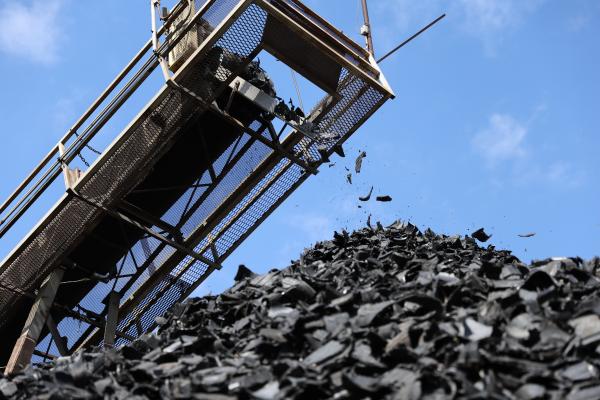
The NC Recycling Business Assistance Center (RBAC) will open the next round of the Scrap Tire Recycling Market Development Grant on July 7, 2026. This funding opportunity supports NC businesses that process scrap tires for recycling and manufacturers that use processed tire materials to create value-added products. Eligible projects include equipment purchases and facility improvements that expand the state's capacity to recycle scrap tires and develop new markets for tire-derived materials.
Interested applicants are encouraged to review program information on the grant webpage and contact Emily Weaver at (919) 707-8913 for questions about the funding opportunity.
Business Opportunities for Increased Diversion in NC Landfill Waste
The 2025 NC Waste Characterization Study presents the results of a multi-season waste sort conducted at three disposal facilities located across the state. The study of the composition revealed that 67% of materials could have been recycled or composted. By identifying readily recyclable materials still being disposed, such as paper, cardboard, metals, plastics, glass, and organics, the study highlights opportunities for recycling businesses to capture lost material value, expand recovery efforts, and support strategic planning for a more resilient materials management system.
NC Department of Environmental Quality (NC DEQ) Division of Environmental Assistance and Customer Service (DEACS) received funding to conduct the study through U.S. Environmental Protection Agency (EPA) Solid Waste Infrastructure for Recycling (SWIFR) program. Thank you to Watauga County, City of Greensboro, and the Coastal Regional Solid Management Authority for participating as sampling locations and hosting field staff to conduct the sorts.
Helene Recovery Recycling Infrastructure Grantees
NC DEQ announced that funding has been awarded for 16 projects in Western NC to enhance waste reduction infrastructure and advance debris management through the Helene Recovery Recycling Infrastructure (HRRI) grant program.
This program awarded $25 million to Hurricane Helene impacted local governments to strengthen waste reduction management systems. These funds support the repair and development of recycling infrastructure and the enhancement of organic debris recovery with the goal of ensuring long-term resilience against future disruptions. See the full press release.
For more information about HRRI funding, visit the Helene Recovery Recycling Infrastructure Grant webpage or contact Matt James at (919) 707-8142.
Land of Sky Regional Council and NC DEQ Partnership Sunsets
The collaboration between Land of Sky Regional Council of Government (LOSRC) and NC DEQ to administer the Waste Reduction Partners program sunsets on June 30, 2026. For over 30 years, this program provided support to organizations in achieving environmental, energy, and carbon management goals through waste reduction, water and energy efficiency, and renewable energy strategies. Participants included agricultural operations, businesses, local government, manufacturers, schools, and institutions across NC.
NC DEQ’s DEACS continues to provide a wide range of technical services to address air emissions, waste reduction, water and energy efficiency, and pollution prevention. DEACS thanks LOSRC for the collaboration and expertise over the years and for the services they provide western NC.
If you are interested in receiving technical assistance or have questions, please reach out to Sarah Robison at (919) 707-8144.
Visit DEACS website for more information.
Check Out our New Grant Page!
DEACS’ Recycling Section has launched a newly consolidated grants webpage, making it easier than ever for partners and communities to find the resources they need. All RMMS grant programs, including Recycling Business Development Grants (RBDG), Food Waste Reduction and Recycling Grants, Community Waste Reduction and Recycling Grants, special grant opportunities, and supporting resources, are now accessible in one central location.
This update also introduces two new tools designed to help recycling businesses and organizations plan stronger, more competitive proposals: the RBDG Frequently Asked Questions and the Grant Calculator.
Recycling Business Development Grants will open on September 2, 2026, but it is never too early to begin preparing. Applicants are encouraged to explore the new page, review updated guidance, and start planning for upcoming funding opportunities.
Visit the Grant Page.
Textile Expo and Ecosystem Tour Showcase Industry Innovation
The Textile Recycling Expo USA and Textile Ecosystem Tour took place in Charlotte, April 28 – 30, 2026, and showcased the growing momentum around textile recycling and circular manufacturing in NC.
Manufacturers, recyclers, brands, and policymakers from across the country gathered to discuss the textile industry and what is needed to build stronger recycling systems in the U.S. Speakers emphasized that meaningful progress will require policy, infrastructure, and private investment working together. There was also strong interest in expanding domestic textile recycling capacity and creating more end markets for recycled materials with innovations in new technology and domestic manufacturing.
The tour showcased multiple innovative NC companies, including Goodwill Industries of Northwest NC, The Industrial Commons, Material Return, Meridian Specialty Yarn Group, Carolina Nonwovens, and more. Together, the tour highlighted the wide range of textile expertise and manufacturing infrastructure that continues to make NC a leader in the textile industry.
Next year, the Textile Recycling Expo USA returns to Charlotte on April 7-8, 2027.
Grantee Spotlight: Material Return
Grant Projects: Building Capacity from the Ground Up
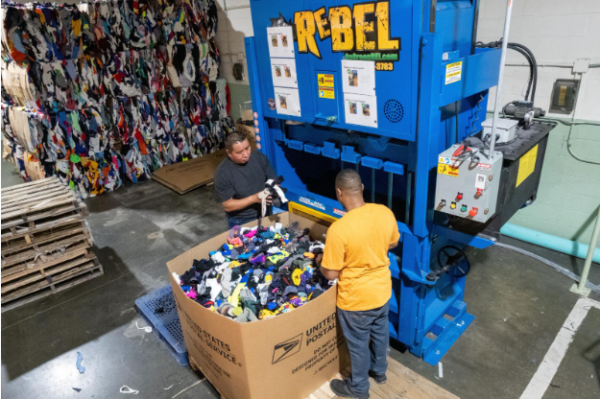
Material Return, a circular economy enterprise housed within the Morganton-based nonprofit The Industrial Commons, has been a recipient of two RBAC Recycling Business Development Grants, designed to expand the company's textile recycling capacity and impact.
The 2020 grant funded the purchase of an industrial baler which cut processing time in half, increased bale weight to approximately 1,200 lbs., and improved overall processing efficiency by 200% compared to the company’s previous equipment. In addition, the project enabled the company to divert more than 500 tons of waste from landfills annually, up from 360 tons per year previously. With this added efficiency, Material Return began processing a wider range of materials including furniture fabric, polyester, cardboard, and selvage waste, and doubled the company’s workforce.
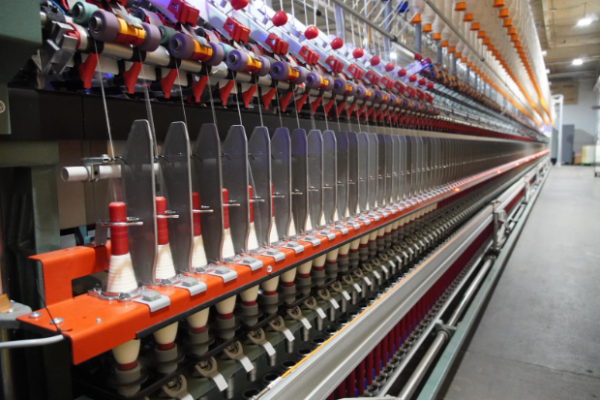
The company’s current RBAC grant project continues that growth trajectory, funding critical small equipment components needed to bring a new yarn spinning line into operation. This new processing line represents a major vertical integration milestone. Material Return already had the infrastructure to produce sliver, the intermediate step before yarn, and the new equipment will allow them to complete the full yarn production process in-house, thereby reducing costs, improving market competitiveness, and lowering the product's carbon footprint.
The Bigger Picture: NC's Textile Innovation Engine
Material Return’s work does not exist in isolation; it is part of a larger effort to position NC as a national leader in circular textiles. In 2024, The Industrial Commons, the nonprofit that houses and supports Material Return, was selected to lead the NSF Textile Innovation Engine of NC, one of the inaugural National Science Foundation Regional Innovation Engines.
The Engine brings together supply chain partners, manufacturers, researchers, educators, and government leaders to advance textile circularity, strengthen domestic manufacturing, support workforce development, and accelerate innovation from fiber to finished product. With the U.S. generating over 17 million tons of textile waste annually, the Engine's Circular Textile Consortium is working to transform that waste stream into valuable raw materials, exactly what Material Return does every day.
The Engine is also investing in workforce development, modernizing high school textile education, and creating career pathways through apprenticeships, micro credentials, and higher education partnerships. Together, Material Return and The Industrial Commons are not just recycling textiles; they are helping rebuild an American textile industry grounded in sustainability, rural economic development, and cutting-edge innovation.
Compost Corner
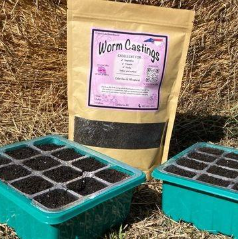
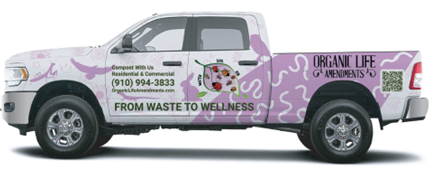
A new composting service provider is now operating in Robeson County! Started in 2024, Organic Life Amendments is a family-owned food scrap hauler and composter in Lumberton, NC. The company collects material from residential and commercial clients and transports it to a partner compost facility for processing. Organic Life Amendments also operates a “continuous flow through” (CFT) vermiculture system. In the CFT, spoiled produce and goat manure are fed to red wiggler worms, and the resulting castings are harvested, packaged and sold at local retailers and online. As part of their hauling and vermiculture operations, the company is partnering with Sustainable Sandhills to collect fruits and vegetables from a local school cafeteria. Lessons learned from the cafeteria compost pilot will be used to expand the program.
Organic Life Amendments is a 2026 Food Waste Reduction grantee and was awarded $60,000 to purchase a pick-up truck, dump trailer and cart tipper to increase food scrap hauling operations.
For more information on composting businesses, contact Organics Recycling Team Lead, Christine Wittmeier, at 919-707-8121.
Staff Updates
RBAC is pleased to announce that Debra Kantner joined the State's recycling office in May as a Recycling Business Development Specialist. Debra comes to us with a strong background in recycling, sustainability, and materials management, with experience spanning research, policy, and program implementation. She will provide assistance to NC recycling companies and manage grant contracts for recycling businesses. Before joining RBAC, Debra was a Research Environmental Engineer with RTI International, working on projects related to food waste and hard-to-recycle materials. She has also spent significant time as a solid waste consultant supporting public and private sector entities with waste reduction, recycling systems, and circular economy strategies. We’re thrilled to have her expertise on board as we continue to grow this work across the Division.
Contact Debra Kantner at (919) 707-8127.
In this issue:
- RBAC Grant in Action: Danny’s Dumpster
- Funding Opportunities Now Open: RBDG and FWR Grants
- Recycling Business Connections is Back
- New Research Highlights the Value of Recyclables Still Going to Landfill in NC
- Powering Up Battery Recycling in North Carolina
- ESI Hosts Industrial Circular Economy Forum
- Compost Corner
- Become a partner of Food Waste Prevention Week
- Workshops, Conferences, and Events
- Funding Finds
RBAC Grant in Action: Danny's Dumpster

Danny’s Dumpster is an independent hauler and organics processor that operates a small Type 3 permitted compost facility in Western North Carolina. In 2013, Danny’s Dumpster purchased an in-vessel compost container with a Recycling Business Development Grant (RBDG) to expand the volume of material and service area of the business. More than a decade later, the same in-vessel compost is still being used with two other in-vessel containers to help process over 1,500 tons of post-consumer food waste each year from Buncombe and Henderson Counties. The Recycling Business Assistance Center (RBAC) recognizes the lasting impact of this previous grant investment, including its continued support of the City of Asheville and Buncombe County’s residential food scrap drop-offs.
Funding Opportunities Now Open: Recycling Business Development Grant and Food Waste Reduction Grant
Requests for Proposals for the 2027 Recycling Business Development Grant and Food Waste Reduction Grant are now open.
The Recycling Business Development Grant (RBDG) program is accepting applications from North Carolina recycling businesses seeking to expand or improve their operations. Funding is available for projects that increase the recovery, processing, or use of recyclable materials in the state through investments in recycling equipment and eligible facility improvements. Eligible projects may increase processing capacity, improve efficiency, expand the use of recycled materials, develop or strengthen end markets, or otherwise support the growth of North Carolina’s recycling economy.
Recycling businesses may apply for up to $75,000, with a 50% cash match required. Applicants should demonstrate a clear need for the proposed investment and describe the anticipated economic and recycling impacts of the project. Priority consideration may be given to projects supporting targeted materials and recycling infrastructure needs identified in the RFP. Applications are due by 5:00 p.m. on Thursday, November 5, 2026.
The Food Waste Reduction (FWR) Grant program is accepting applications for initiatives that reduce the amount of wasted food being disposed of in landfills. Eligible applicants include North Carolina-based compost and anaerobic digestion facilities, organics haulers, local governments, and food recovery organizations that currently manage or plan to manage excess or wasted food to divert it from landfills.
With only a 20% cash match, two tiers of funding are available: 2027 FWR Priority Project Grants for up to $60,000 for projects deemed critical to growing food waste reduction efforts in the state, with priorities including edible food recovery and processing and/or hauling of post-consumer food scraps. Standard Project Grants offer up to $40,000 for other projects that divert wasted food from landfills, such as equipment to expand pre-consumer organics management. Applications are due by 5:00 p.m. on Thursday, November 5, 2026.
Click here for more information on both grant programs.
Recycling Business Connections is Back!
We are excited to announce the return of Recycling Business Connections (RBC) on Wednesday, October 7, 2026, from 4:00–7:00 p.m. at the Charlotte Convention Center.
This networking event brings together members of the circular economy, including recycling processors and manufacturers, haulers, equipment providers, and business & industry reps from across the supply chain. This is your chance to boost your footprint in the Carolinas with activities designed to help you make meaningful connections and grow your business.
This event is provided in partnership with the NC Division of Environmental Assistance and Customer Service (DEACS), SC Department of Commerce, Carolina Recycling Association (CRA), Charlotte Regional Visitors Authority, and the Charlotte Green Team.
Register Now! Rates are $90 for CRA members and $105 for non-members.
Sponsor RBC! Check out the sponsorship packages, which may include opportunities to speak, dedicated exhibit space, tabletop display, registration, and more.

New Research Highlights the Value of Recyclables Still Going to Landfill in NC
One of the biggest takeaways from recent statewide recycling research is the amount of recyclable material still being disposed of each year. An economic analysis of the Waste Characterization Study estimated that roughly 2 million tons of selected recyclables were disposed of in 2025, representing more than $372 million in material value. An estimated $104 million in tipping fees were also paid to landfill those materials.
Those recyclables were estimated to take up about 3.67 million cubic yards of landfill space. The analysis also estimated that diverting all recyclables could extend statewide landfill capacity by about 6.4 years and reduce greenhouse gas emissions by an amount equivalent to removing roughly 1.49 million passenger vehicles from the road.
Together, the SWIFR-funded research gives us a better picture of the whole recycling system, including what valuable materials are discarded in landfills and the challenges faced by facilities working to recover those materials.
On the recovery side, the MRF assessment identified 17 MRFs across North Carolina that processed about 603,000 tons in 2024. Facilities identified contamination, lack of labor, aging equipment, and insufficient space as key areas for improvement.
The conclusion of the SWIFR-funded research demonstrated the significant value of recyclable materials currently being disposed of in landfills. Key opportunities identified include facility expansion, additional grant funding, public recycling education, and new equipment. DEACS will use this enhanced understanding of the state’s waste stream and recycling facilities to help guide future infrastructure and market development efforts across North Carolina.
Funding for this research was provided through North Carolina’s three-year, $612,441 U.S. EPA Solid Waste Infrastructure for Recycling (SWIFR) grant. The project includes a statewide Waste Characterization Study, an assessment of North Carolina material recovery facilities (MRFs), an evaluation of recycling market opportunities and needs, and modeling of future recycling processing needs.
Powering Up Battery Recycling in NC

Starting December 1, 2026, North Carolina will ban lithium-ion batteries from disposal. Lithium-ion batteries are rechargeable and power devices like tablets, cell phones, and power tools. As recyclers know well, these batteries can spark fires in collection vehicles, recycling facilities, and landfills when discarded in trash or recycling bins.
DEQ recently launched the ‘Skip the Bin! Turn Your Batteries In!’ campaign to provide information for communities, businesses, and the public through web resources and media ads. The batterysafe.nc.gov website provides guidance on managing end-of-life lithium-ion batteries.
DEQ has begun releasing a series of radio and digital ads to educate the public about safe battery handling and promote the website. If your company generates lithium-ion batteries as waste, check out the business resources to learn how the upcoming policy may apply to your operations, evaluate your current battery management practices, and identify appropriate pathways for the collection and management of lithium-ion batteries. Battery processors and recyclers may receive more questions from customers as radio and digital ads air throughout the fall and as more public attention is focused on safe battery disposal options.
This campaign is expected to increase the amount of lithium-ion batteries diverted for recycling across the state. To support the anticipated increase in material, lithium-ion battery recycling is a priority area for this year’s Recycling Business Development Grant (RBDG). Companies certified through R2 or e-Stewards that are seeking to expand or improve their operations to handle lithium-ion batteries should consider applying. Applications are now open. More information on the RBDG can be found here.
Contact RBAC to learn more about the ‘Skip the Bin! Turn Your Batteries In!’ campaign or visit batterysafe.nc.gov.
ESI Hosts Industrial Circular Economy Forum

On June 3, 2026, thirty Environmental Stewardship Initiative (ESI) members gathered at Atlantic Packaging in Charlotte for the Industrial Circular Economy Forum. Presenters from NC DEQ, Atlantic Packaging, Fiberon, CRC Recycling, Unifi, Freudenberg, Southeastern Container, and the Association of Plastic Recyclers (APR) spoke about the existing challenges and new trends for industrial recyclers.
The theme of the event was sustainable packaging. Atlantic Packaging staff gave attendees a tour of their facility to test the performance of lightweight packaging with recycled content. Attendees discussed how their respective organizations have weathered volatile recycling markets and sought new opportunities to introduce more post-industrial content into their packaging.
If you are interested in joining ESI or hosting an ESI tour, please contact Matt James at matt.james@deq.nc.gov or 919-707-8142.
Compost Corner
Become a partner of Food Waste Prevention Week (Sept. 28 – Oct. 4)
Food Waste Prevention Week (FWPW) will take place Sept. 28 through Oct. 4, 2026. FWPW is an initiative that educates, connects, and provides businesses, organizations, and individuals with resources to reduce food waste.
With more than 700 partners in 49 states and 14 countries, FWPW is a global network where businesses and organizations can share experiences, materials, resources, and educational practicums. You and your organization can gain access to an ever-growing community that aims to connect people and organizations interested in raising awareness and changing behavior to reduce wasted food. To become a partner, go to Food Waste Prevention Week's Partner Form.
Workshops, Conferences, and Events
- Recycling Business Connections (RBC): October 7, in Charlotte, North Carolina
- CDRA Shingle Recycling Forum: October 13–15, 2026, in Raleigh, North Carolina
- MRF Operations Forum: October 26–27, 2026, in Chicago, Illinois
- Paper and Plastics Recycling Conference: October 28–29, 2026, in Chicago, Illinois
- Environmental Stewardship Initiative Annual Conference: October 29–30, 2026, in Raleigh, North Carolina
- Critical Minerals, Battery Recycling & E-Waste Expo: October 28–29, 2026, in Atlanta, Georgia
- Introduction to Thermoforming: November 3–4, 2026, at The Polymers Center in Charlotte, North Carolina
- North American Biochar Conference: November 16–18, 2026, in New Orleans, Louisiana
- CDRA Annual Conference: January 26–28, 2027, in Bonita Springs, Florida
Funding Finds
The U.S. Composting Council (USCC) launched its 2027 Young Professionals (YP) Emerging Composter Challenge. The USCC is looking for professionals working and innovating within the fields of composting, compostable products, organics recycling, or zero waste to submit their projects for the Emerging Composter Challenge at COMPOST2027. Participants have a chance to showcase their work and compete for cash prizes up to $4,000! The application closes November 30, 2026.
NC Composting Council’s (NCCC) 2027 Grant is now open. NCCC is seeking composting and compost use projects in North Carolina that benefit a community, organization, or the composting industry. Projects intended solely for personal or home use are not eligible. While not required, preference will be given to projects that include a plan for long-term financial and program sustainability beyond the grant period. If you have questions about your project's eligibility, please contact Kat at Kat@carolinacompost.com. The application closes Tuesday, October 13, 2026, at 11:50 p.m.
Wake County Solid Waste Management’s Waste Prevention Grant Program is now open. Schools, nonprofits, and businesses can apply for $1,000 to $10,000 to support projects that reduce waste sent to the landfill, including recycling, composting, reuse, and repair efforts. The application closes Friday, October 16, 2026, at 11:59 p.m. All applicants must be located in Wake County.