
Sheepshead Management
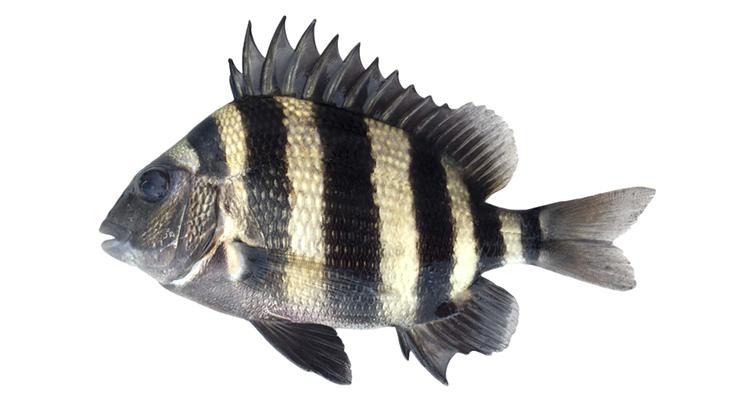
Sheepshead Management Issue Paper
Due to increases in fishing pressure, particularly on juvenile fish, and a decline in older fish observed in recent years, the Division implemented management changes in March 2026 for sheepshead.
Current Sheepshead Management Regulations
Recreational Regulations
- Size Limit: 14-inch total length minimum size limit
- Bag Limit: Five-fish per person per day
Commercial Regulations
- Size Limit: 14-inch total length minimum size limit
- Trip Limits:
- Pound Nets-1,500 pounds per operation per day
- Gigs and Spears-10 fish per person per day or trip (even if the trip occurs over more than one calendar day)
- Other Gears-300 pounds per trip
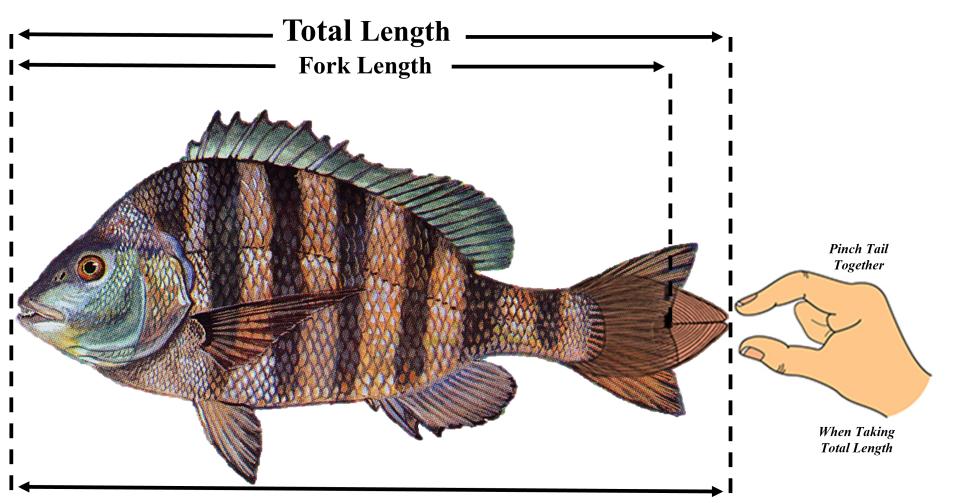
Notice that the size limit is no longer be measured as fork length (from the tip of the snout to the fork in the tail). The new regulations require measuring total length (from the tip of the snout to the longest part of the tail when compressed). The measurement changes align with regulations for Black Drum, a similar looking species commonly caught alongside Sheepshead. Aligning the measurement point between the two species simplifies regulations for the public.
The Division considered public input provided during the fall public comment period in determining management changes.
For more detailed information, review the presentation that was given to the Marine Fisheries Commission in August 2025 (see the video below) and the Issue Paper.
Fishery Trends
About 85% of Sheepshead landings come from recreational fishing and about 15% come from commercial fishing. A recent review of data indicated a suite of trends that are concerning for a relatively long-lived species with high site fidelity. Together, they provide compelling evidence of the need for proactive management.
After an initial drop in landings when management was implemented in 2015, landings have shown an increasing trend (and been on par with pre-regulation values; Figure 1). Recreational landings in 2024 were 1.42 million pounds, the highest since management was implemented, the highest of the time series shown, and the second highest recorded recreational landings (behind 2007, see annual update).
Not only have landings increased, the number of directed trips has also increased. Between 2020 and 2021, effort more than doubled after being relatively stable for the previous decade. Effort has remained high, even when landings dropped in 2023.
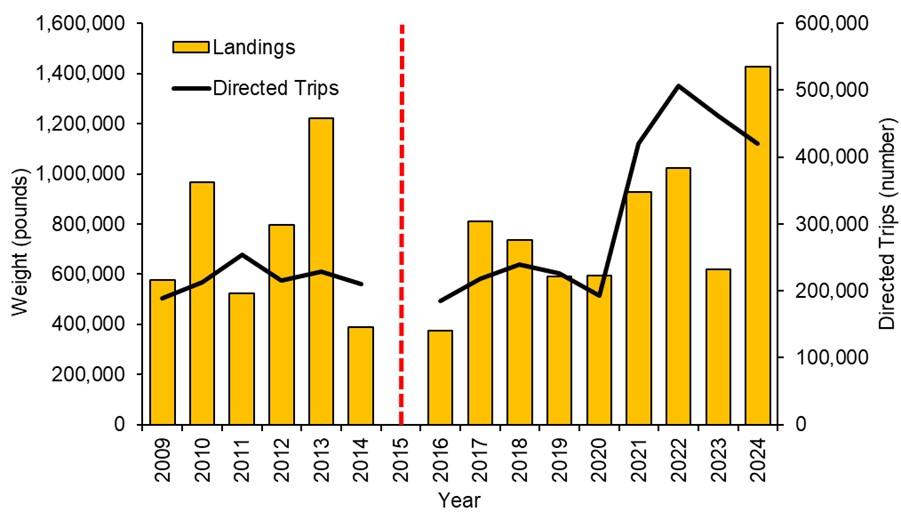
Figure 1. Sheepshead recreational landings (pounds) and directed trips (number), 2009–2024. Data from 2015 were excluded due to timing of management implementation part way through the year. (Source: National Marine Fisheries Service Marine Recreational Information Program). Data from 2015 were excluded from all analyses due to timing of management implementation. The dashed red line on all bar graphs indicates when size, bag, and trip limits were implemented through Proclamation FF-28-2015. (Source: North Carolina Trip Ticket Program).
Though the majority of anglers only land one fish, in the last 5 years there has been a slight increase in the proportions of anglers landing 2-4 fish (Figure 2). This change in success, even slight, likely contributed to the observed increase in landings. Increased success coupled with increased effort and interest (both realized and anecdotal) raises concerns about harvest levels and current management.
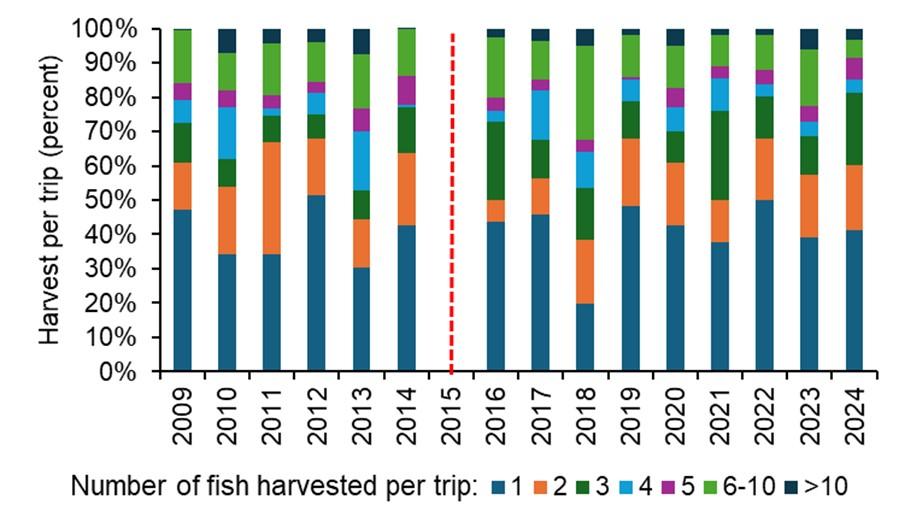
Figure 2. Percent of recreational sheepshead harvested per trip (one or more anglers), 2009–2024. Data from 2015 were excluded due to timing of management implementation part way through the year. (Source: National Marine Fisheries Service Marine Recreational Information Program).
Another concerning trend is that a large portion of fish harvested are younger and potentially immature (Figure 3). Since 2016, 85% of the landings are 16 inches or less, meaning that most of them were immature.
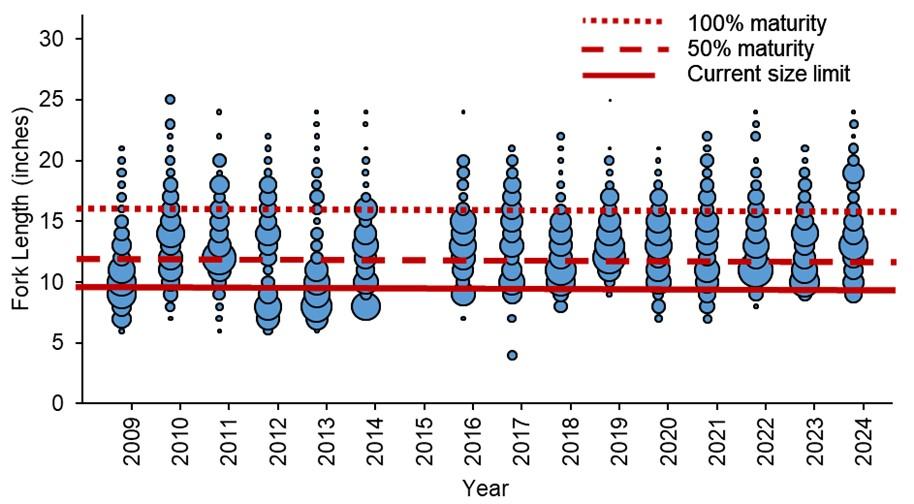
Figure 3. Length frequency of sheepshead harvested in the recreational fishery. The larger the bubble the more fish that were observed at that length, and the dark red horizontal bars represent the current 10-inch fork length minimum size limit, and size at 50% and 100% maturity.
Effort in the commercial fishery has been more variable across years after the 2015 implementation of new regulations (Figure 4). Nevertheless, landings showed a marked increase in 2023 and again in 2024. And as with the recreational fishery, the landings in 2024 were the highest since management was implemented. These increases come during years with relatively moderate number of trips meaning that pounds per trip have increased for pound nets and other non-spear/gig gears (Figure 5). There are several possible reasons for the increases in trips with higher landings for both gear types shown. For example, regulation changes in other fisheries have made sheepshead a more desirable species to retain or target.
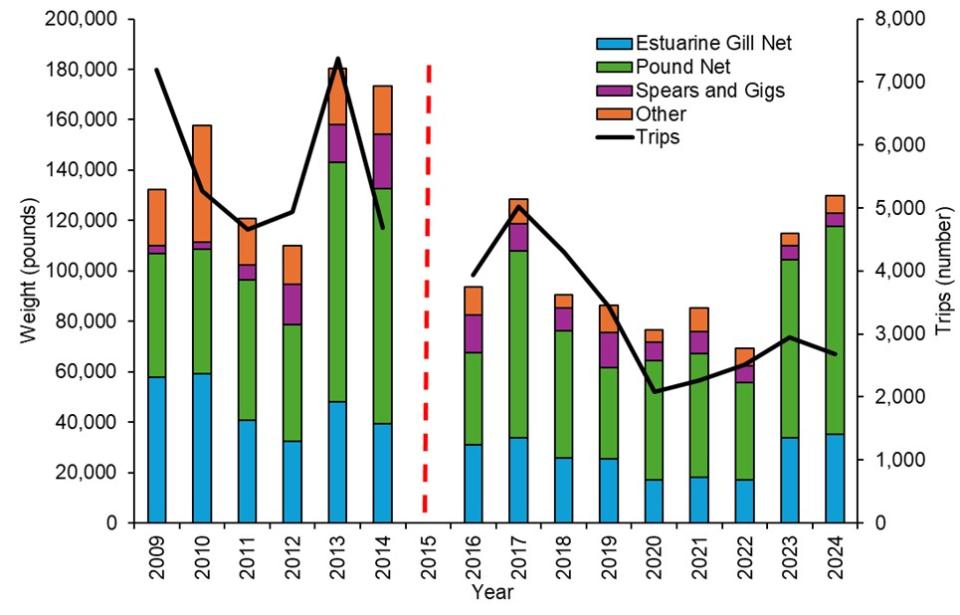
Figure 4. Annual sheepshead commercial landings (pounds, left axis) by gear type and trips (number, right axis), 2009–2024. Data from 2015 were excluded due to timing of management implementation part way through the year. (Source: North Carolina Trip Ticket Program).
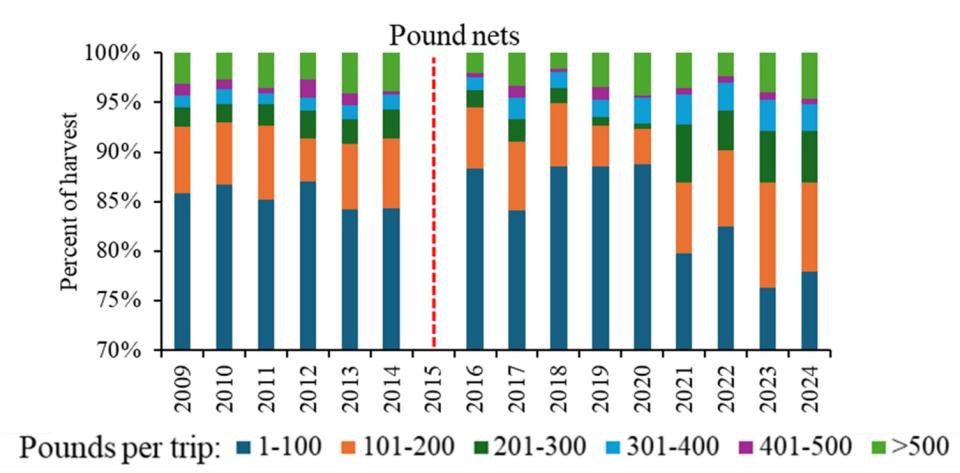
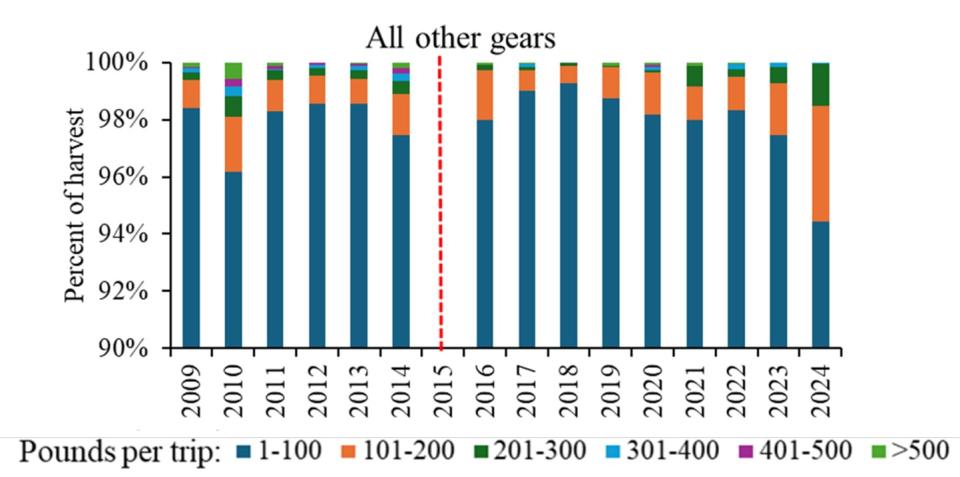
Figure 5. The proportion of commercial sheepshead harvest for pound nets (top) and other gears (excludes gig/spear; bottom) where bar color refers to the range of pounds (e.g., 0-100 lb) harvested per trip, 2009–2024.
Similar to the recreational fishery, a large portion of sheepshead harvested in the commercial fishery are younger and potentially immature fish (Figure 6). From 2016–2024, 87% of the landings are 16 inches or less; below the length of 100% maturity (shown by the dotted red line).
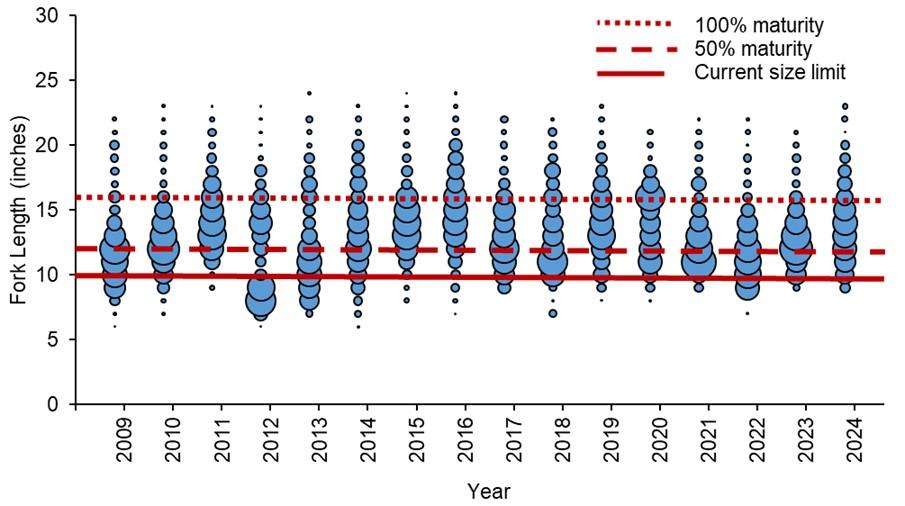
Figure 6. Commercial length frequency (fork length, inches) of sheepshead sampled from landings, 2009–2024. Bubbles represent fish at length and the bubble size is proportional to the number of fish at that length. (Source: National Marine Fisheries Service Marine Recreational Information Program).
Due to the suite of concerning stock indicators and trends in the recreational and commercial fisheries described above, the Division has concluded proactive management is necessary to prevent harm to the stock. Otherwise, increases in fishing pressure could lead to localized depletion of larger, older fish, which has implications for reproduction and population abundance.